Tourist SIM vs eSIM at US Airports: Is Buying on Arrival Worth It?
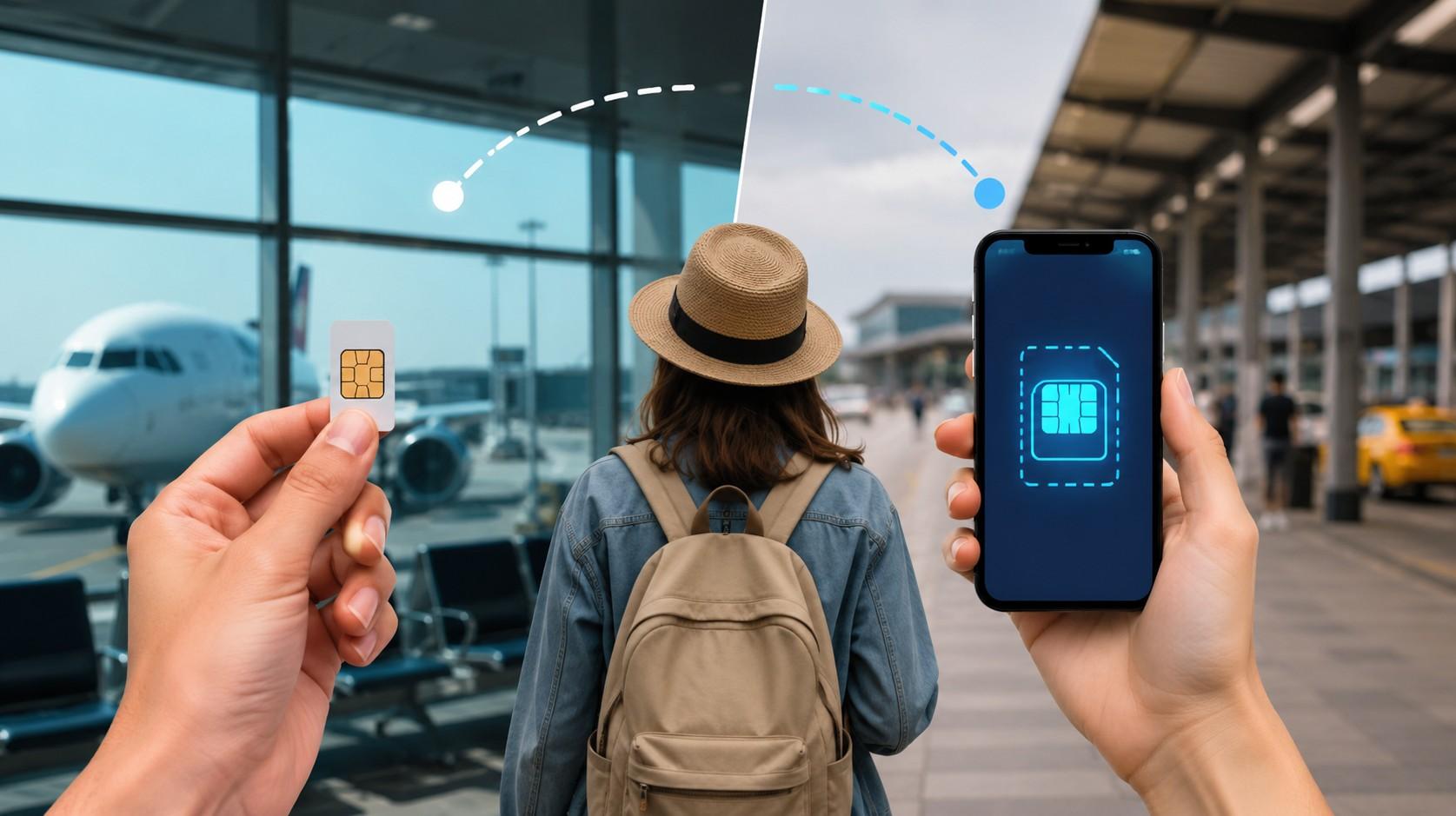
An airport tourist SIM is a prepaid physical card sold from a kiosk, vending machine or electronics store inside a US arrivals terminal, priced for convenience rather than value. A travel eSIM is the same connectivity bought online and installed before departure. On price the gap is wide: the cheapest SIM in the JFK arrivals hall costs $29 for 1 GB, while Vesim United States plans start at $0.60.
Convenience is what airport retail sells, and it is worth less than it looks. Kiosks at JFK, LAX, ORD, SFO, MIA, ATL and LAS mark plans up 30% to 50% over the same data bought online or from a Walmart in the city. Activation or convenience fees of $10 to $25 appear on many purchases. LAX Terminal 2 starts at $82 for 10 GB and reaches $120 for unlimited, which is among the highest airport SIM pricing observed anywhere in the world.
Availability is patchier than travelers expect. JFK has no staffed SIM shop in arrivals at all, only four vending machines selling international roaming cards rather than AT&T, T-Mobile or Verizon products. LAX sells physical cards only, with no eSIM option at the counter. Smaller airports including Nashville, San Antonio and Portland often stock nothing.
This guide compares both routes for a real arrival. It covers what each major US airport actually stocks, 2026 pricing terminal by terminal, why the markup exists, the difference between staffed kiosks and unstaffed vending machines, what the same data costs bought in advance, the time cost of queuing after a long-haul flight, and the narrow cases where buying on arrival still makes sense. Compare against the United States eSIM plan list as you read.
What you actually find at US airports
American airports handle SIM retail worse than most international hubs. There is no equivalent of the staffed carrier desks common at Bangkok, Dubai or Istanbul arrivals.
Here is the realistic picture at the busiest gateways:
JFK, New York. No official carrier store in arrivals. Four vending machines in the arrival hall sell prepaid international roaming SIMs, not T-Mobile or AT&T products. Cheapest option is $29 for 1 GB, with no staff to help register or activate.
LAX, Los Angeles. One Currency Exchange counter and the InMotion store in Terminal 2 stock two T-Mobile-based tourist cards, both valid four weeks. Physical SIMs only, no eSIM sold on site.
ORD, Chicago O’Hare. Electronics kiosks stock prepaid cards from T-Mobile and AT&T, with prices in the $40 to $60 range for 10 GB.
MIA, Miami. Kiosks in the international arrivals area sell prepaid cards, though stock varies by terminal and time of day.
SFO, San Francisco. Limited kiosk availability, generally T-Mobile-based tourist packages.
EWR, Newark. Vending machine coverage similar to JFK, with the same international roaming products.
Two structural problems repeat across all of them. Nobody staffs the vending machines, so activation failures have no remedy. And several sell international roaming SIMs rather than domestic American plans, which means slower speeds on a partner network rather than a direct AT&T or T-Mobile connection. Pricing follows the same pattern.
US airport SIM prices in 2026
Airport pricing sits well above what the same data costs anywhere else in the country. These are the figures travelers report at the major terminals.
Airport
Cheapest option
Larger plan
Notes
JFK Terminal 4
$29 for 1 GB
$50 for 10 GB
Vending machines only, no staff
LAX Terminal 2
$82 for 10 GB
$120 unlimited
Four-week validity, physical only
ORD
$40 for 10 GB
$60 unlimited
T-Mobile and AT&T stock
Typical US airport kiosk
$30 to $50
$50 to $70
Plus $10 to $25 activation
City-center pricing for the same products runs 30% to 50% lower. A T-Mobile 10 GB plan costing $50 to $60 at an airport kiosk sells for around $40 at a Walmart, Target or Best Buy, and roughly $30 direct from the carrier online.
Vending machine pricing is the worst value in the category. Paying $29 for a single gigabyte works out at $29 per gigabyte, roughly ten times what a travel eSIM charges and twenty times what a large fixed-data plan delivers. The reasons behind the premium are worth understanding before deciding it is unavoidable.
Why airport SIM cards cost more
Four costs sit inside every airport retail price, and none of them relate to the data itself.
Terminal rent. Airside retail space at JFK and LAX carries some of the highest square-foot rates in American commercial property. That rent lands in the product price.
Captive demand. A passenger who has just cleared immigration with no connection has limited alternatives and limited energy to search for them. Pricing reflects the absence of competition at the point of sale.
Small stock volumes. Kiosks turn over a fraction of the volume a Walmart moves, so wholesale terms are worse and margins per unit must be higher.
Activation labor. Staffed counters register your passport, set up the line and troubleshoot. That service is real and it is charged for through the $10 to $25 activation fee.
None of those costs exist online. A travel eSIM has no shelf, no rent, no stock and no staff at the point of purchase, which is why the same gigabytes cost a fraction as much. Whether a human is present at all changes the experience substantially.
Vending machines against staffed kiosks
The two formats fail in opposite directions, and knowing which one your arrival terminal has matters.
Vending machines take international credit cards and USD notes, dispense a card, and leave you to it. Registration and activation are your problem. If the SIM does not connect, nobody is standing there to fix it, and the machine issues no refunds. JFK and Newark rely heavily on this model.
Staffed kiosks register your passport, insert and activate the card, and confirm the connection works before you walk away. That service justifies part of the premium, and it genuinely helps travelers unfamiliar with American networks. The cost is time: arrival banks at LAX and Miami produce queues past 20 minutes in the late afternoon.
Neither format solves the underlying issue. You are buying at the worst moment, in the worst location, at the worst price, after the longest possible period without sleep. The alternative reverses all four conditions.
What the same connectivity costs bought in advance
Travel eSIM pricing bought online before departure sits far below any airport shelf. Vesim United States plans start at $0.60, and the wider market prices roughly as follows:
1 GB for 7 days at $3 to $5, against $29 from a JFK vending machine
5 GB for 15 days at $10 to $18
10 GB for 30 days at $14 to $30, against $50 to $82 at an airport counter
20 GB for 30 days at $25 to $45
Unlimited for 15 days at $25 to $40, against $120 at LAX
No activation fee applies. No passport scan is required. No stock can run out. Payment clears through Stripe and the QR code lands in your inbox within seconds of checkout.
Coverage is generally better too. Travel eSIMs connect through wholesale agreements with AT&T, T-Mobile or Verizon, while several airport vending machines sell international roaming products that ride a partner network at lower priority. Money is only one of the two things airport buying costs.
The time cost of buying on arrival
Arrival is the single worst moment to shop for connectivity, and the delay compounds through everything that follows.
A realistic sequence at a large US airport looks like this: clear immigration in 30 to 60 minutes, collect baggage, locate the kiosk, queue for 15 to 25 minutes, present a passport, complete registration, wait for activation, then troubleshoot if the card refuses to register. Forty-five minutes disappears easily.
Meanwhile the tasks you actually need data for are already waiting. Rideshare pickup zones at LAX sit in a separate area reached by shuttle, and finding it without a live map is genuinely difficult. Hotel confirmations sit in an email you cannot open. A family member waiting for your landing message gets nothing.
An eSIM installed at home reverses the whole sequence. You switch off airplane mode at the gate, the profile registers on an American network within two or three minutes, and you walk out already booking a car. The pre-flight setup costs about five minutes on your own sofa.
Airport retail is not always the wrong choice, though the cases are narrower than they look.
When buying at a US airport still makes sense
Three situations genuinely favour the kiosk.
Your phone has no eSIM support. Handsets older than the iPhone XS, Google Pixel 3 or Samsung Galaxy S20 cannot install a profile, and some carrier-locked devices block it. Dial *#06# before you fly and check for an EID.
You need a US phone number immediately. A carrier prepaid SIM includes a +1 line that receives SMS, which matters for American bank verification, Zelle, Venmo and a few app signups. Data-only eSIMs cannot supply this. Our guide on whether a US number or data alone is enough works through the decision.
Your eSIM failed and you have no Wi-Fi. Rare, and mostly avoidable by installing days ahead rather than at the gate, but a physical card is a reasonable fallback.
Outside those cases, the arithmetic points one way. The final step is making sure the eSIM route works cleanly.
The pre-flight setup that removes the decision
Five minutes at home replaces the entire arrival queue. Work through this order the day before you fly:
Check compatibility by dialing *#06# and confirming an EID appears.
Choose a United States plan sized to your trip length and data habits.
Complete checkout and open the QR code emailed to you.
Scan the code in your phone settings and label the new line clearly.
Leave the line switched off until you land, which protects the validity window.
Disable data roaming on your home SIM so it stops charging in the background.
After landing, enable data roaming on the eSIM line and set it as your default data connection.
Installing early leaves room to contact support if anything refuses to install, which is exactly the safety margin an airport purchase never gives you. Vesim answers support email 24 hours a day, and the same account covers 220+ destinations if your itinerary continues past America.
Can you buy a SIM card at JFK Airport?
Yes, but only from vending machines. JFK has no staffed SIM shop or carrier store in the arrivals hall. Four machines sell prepaid international roaming cards starting at $29 for 1 GB, with no assistance available for registration or activation failures.
How much does a SIM card cost at a US airport?
Airport SIM cards cost $29 to $82 for entry-level data plans, with unlimited packages reaching $120 at LAX. Activation or convenience fees of $10 to $25 apply at many counters. The same plans sell for 30% to 50% less at city stores or online.
Which US airports sell SIM cards?
JFK, LAX, ORD, SFO, MIA, ATL, LAS and EWR all offer some form of SIM retail, whether staffed kiosks, electronics stores or vending machines. Availability varies by terminal and time of day. Smaller regional airports frequently stock nothing at all.
Can I buy an eSIM at a US airport?
Generally no. LAX and JFK sell physical cards only, and most American airport retail has not adopted eSIM distribution. Buying an eSIM online before departure is the practical route, and installation takes about five minutes at home.
Is it cheaper to buy a SIM card at the airport or online?
Online is substantially cheaper. A 10 GB travel eSIM costs $14 to $30 bought online against $50 to $82 at an airport kiosk. Vending machine pricing at $29 for 1 GB works out roughly ten times the online rate per gigabyte.
Do I need a passport to buy a SIM card at a US airport?
Yes for staffed counters, which register your identity as part of activation. Vending machines skip the check but also skip the help. Travel eSIMs bought online require no identity document at all, only an email address and a payment method.
How long does it take to buy a SIM at a US airport?
Expect 30 to 45 minutes including the queue, registration, activation and any troubleshooting. Afternoon arrival banks at LAX and Miami produce the longest waits. An eSIM installed before departure connects within two or three minutes of switching off airplane mode.
Are airport SIM cards on AT&T, T-Mobile or Verizon?
Sometimes. Staffed kiosks at LAX and ORD stock T-Mobile and AT&T products. JFK and Newark vending machines sell international roaming SIMs that ride partner networks at lower priority, which usually means slower speeds during congestion.
What happens if my airport SIM does not work?
At a staffed kiosk, the assistant troubleshoots before you leave. At a vending machine, nothing happens, because there is no refund mechanism and no support presence. That asymmetry is the main practical argument against the vending machine format.
Should I buy an eSIM before or after landing in the USA?
Before. Buying after landing means finding airport Wi-Fi, completing a purchase on a congested network, and installing a profile without help if something fails. Purchase does not start the validity clock, which begins when the profile registers on a US network.
Can I buy a SIM card outside the airport instead?
Yes, and it costs less. Walmart, Target, Best Buy and carrier stores in the city sell the same plans at 30% to 50% below airport prices. The trade is time and a journey into town, which most travelers would rather spend on the trip itself.
Does a travel eSIM give me a US phone number?
No. Vesim United States plans are data-only, like most travel eSIMs. Calls and messages run through WhatsApp, FaceTime and similar apps while your home number stays live on your original SIM. A carrier prepaid card is the route to a +1 number that receives SMS.
The short version
An airport tourist SIM is a prepaid physical card sold inside a US arrivals terminal, and it prices for the moment rather than the product. JFK offers only vending machines at $29 for 1 GB with nobody to help. LAX sells physical cards from $82 for 10 GB and no eSIM at all. Across the major gateways the markup runs 30% to 50% over city and online pricing, with activation fees of $10 to $25 on top.
Rent, captive demand, small stock volumes and activation labor explain the premium, and none of those costs exist online. A travel eSIM delivers the same gigabytes on the same AT&T, T-Mobile and Verizon infrastructure from $0.60, with no fee, no passport scan and no queue after a long-haul flight.
Buying on arrival still makes sense on a phone without eSIM support, or when a +1 number is a hard requirement for US bank verification. Otherwise the setup takes five minutes at home: check for an EID, choose a plan, scan the code, leave the line off until you land. Browse United States eSIM plans and walk past the kiosk.