International Travel Checklist: What to Do Before You Fly
An international travel checklist is a dated list of the documents, bookings, health steps, money settings and packing tasks you finish before a flight that crosses a border. Most of it falls into three windows: two to three months out, two weeks out, and the final 48 hours.
Your passport sets the first deadline. Many countries refuse entry unless it stays valid for six months past your return date, and the U.S. Department of State quotes 4 to 6 weeks for routine renewal, plus mailing time in both directions. Visas and electronic travel authorizations come next: the ESTA for visitors to the United States, the UK ETA, and the EU’s ETIAS, which Brussels plans to switch on in the last quarter of 2026.
Health and money follow. The Centers for Disease Control and Prevention (CDC) suggests booking a travel clinic visit at least a month before departure, since some vaccines need weeks to take effect. Travel insurance covers medical bills that Medicare and most U.S. health plans won’t pay abroad. A card with no foreign transaction fee saves the roughly 3% many banks add to every purchase overseas.
Then come the practical pieces. An eSIM installed at home gives you mobile data the minute the plane lands, without paying carrier day passes. The Smart Traveler Enrollment Program (STEP) links you to the nearest U.S. embassy, and TSA’s 3-1-1 liquids rule shapes the carry-on.
Passport, visa and entry documents
Passport validity is the item that ends trips at the check-in desk. Open your passport today and read the expiration date. If it’s close to your return, renew now. Expedited service costs an extra $60 and cuts processing to 2 to 3 weeks. Some countries also want two blank visa pages.
Entry rules differ by destination and change often. Check three things on the State Department’s country information page for every country you’ll enter, layovers included:
Visa type, cost and processing time
Electronic authorization, such as the UK ETA, Canada’s eTA or Australia’s ETA
Proof of onward travel, hotel bookings or funds
Europe added the Entry/Exit System (EES) in October 2025, which records fingerprints and a facial image at Schengen borders instead of passport stamps. ETIAS will add an online authorization on top once it launches. Apply through the official EU site only, since lookalike agency sites charge several times the real fee.
Keep the paperwork findable. Save scans of your passport photo page, visas and insurance policy to a cloud folder, and carry one paper copy separate from the passport. Those copies speed up a replacement at a U.S. embassy. Once documents are settled, insurance and health come next.
Travel insurance and health preparation
Insurance comes first because coverage starts on the day you buy it, and a policy bought soon after your first trip deposit usually gets the widest cancellation benefits. Look for four lines in the policy wording:
Emergency medical coverage, ideally $100,000 or more
Medical evacuation
Trip cancellation and interruption limits
Baggage delay and loss allowances
Original Medicare doesn’t pay for care outside the United States in most cases, and many private plans treat foreign hospitals as out of network.
Health checks take longer to arrange than people expect. Bring your itinerary to the travel clinic so the clinician can check routine shots and advise on destination vaccines. Yellow fever proof is mandatory for entry to some countries in Africa and South America. Pack prescription medicine in its original labeled container, with a few spare days’ supply.
Medical bills abroad usually go on a credit card, so the next job is making sure your cards actually work overseas.
Money, cards and currency
Cards are the main payment tool in most destinations now, but the wrong card costs money on every swipe. Many travel credit cards charge no foreign transaction fee, so check your card terms before you go.
Do these before you leave:
Confirm your card works abroad through a quick app check
Pack two cards from different networks, such as Visa and Mastercard, in case one is declined
Withdraw a little local cash at an airport ATM on arrival instead of an exchange counter at home
Decline dynamic currency conversion, the offer to charge you in dollars, because the merchant’s exchange rate is almost always worse
Write your bank’s international phone number somewhere outside your phone. And remember that banking passcodes arrive by SMS, which makes your phone setup part of your money plan.
Phone and data: set up an eSIM before you leave
Connectivity is the item travelers most often leave until the airport, and it costs the most when it goes wrong. Roaming day passes from AT&T, Verizon and T-Mobile typically run $10 to $12 on many plans, so two weeks abroad adds up fast.
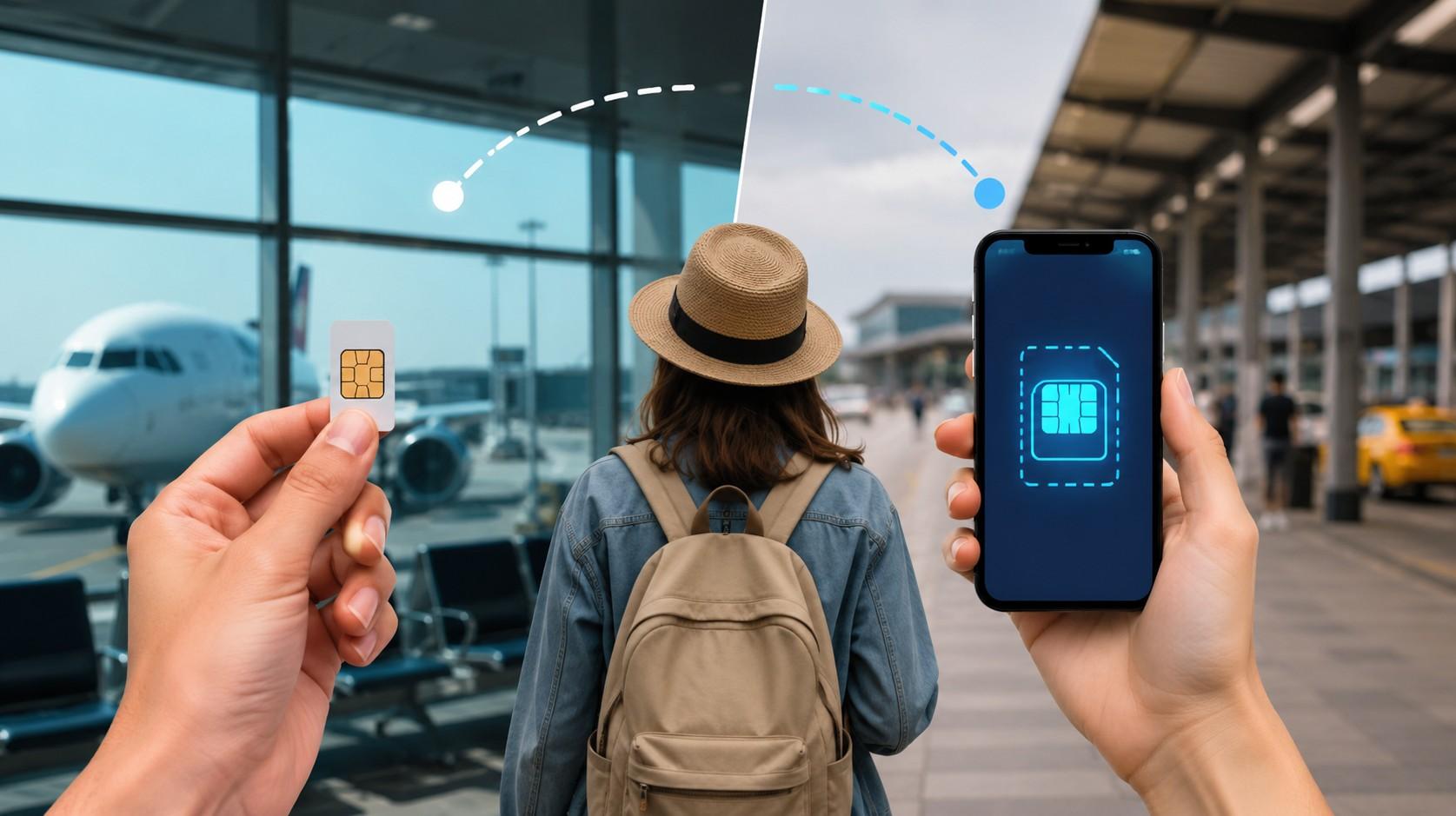
An eSIM (embedded SIM) is a digital SIM profile you download to your phone instead of inserting a plastic card. It lets you add a local data plan while your home number stays active for calls and SMS codes. Supported phones include iPhone XS and newer, Google Pixel 3 and newer, and Samsung Galaxy S20 and newer. The phone must also be carrier unlocked.
Setup takes about five minutes at home on Wi-Fi:
Check eSIM support under Settings, then Cellular (iPhone) or Connections (Android).
Buy a data plan for your destination country.
Scan the QR code or use the install link to add the eSIM profile.
Label it “Travel” and leave data roaming off until you land.
On arrival, switch mobile data to the travel line and turn roaming on for that line only.
Vesim sells eSIM plans for 220 countries and destinations, with prices starting from $0.60. Activation is instant, there’s no physical SIM to collect, and more than 10,000 travelers use it. Plans are set up per country, so a trip to Tokyo uses the Japan eSIM page, while a London stopover uses the United Kingdom plans. Check data allowance, validity days and hotspot use on each plan page before you buy. A working data line keeps your boarding pass, maps and booking apps live from the jet bridge onward.
Bookings, copies and safety registrations
Bookings deserve one final pass two weeks out. Confirm flight times, seats and hotel dates, since airlines change schedules months ahead without much notice. Download offline maps of your arrival city in Google Maps.
Several government programs save time or add a safety net:
STEP (Smart Traveler Enrollment Program): free registration that lets the nearest U.S. embassy contact you during a natural disaster or civil unrest
Global Entry: faster U.S. customs on return, valid five years, and it includes TSA PreCheck
Mobile Passport Control: a free CBP app that shortens arrival lines at many U.S. airports
Emergency contacts: a copy of your itinerary shared with one person at home
Global Entry interviews can book up weeks ahead, so apply early or plan on Enrollment on Arrival at a participating airport. With bookings confirmed, packing becomes a short job.
Packing and carry-on rules
Packing starts with your airline’s baggage page, because American, United and Delta set limits per class and route. Most economy checked bags cap out at 50 pounds (23 kg).
The TSA 3-1-1 rule governs liquids at U.S. checkpoints: containers of 3.4 ounces (100 ml) or less, all in one quart-size bag, one bag per passenger.
Your carry-on should hold anything you can’t replace overnight:
Passport, wallet and printed copies
Prescription medicine and glasses
Phone charger, power bank and a plug adapter for your destination’s socket type
One change of clothes for a delayed bag
Power banks with lithium batteries must ride in the cabin, never in checked luggage. Check the voltage label on hair dryers too, since the United States runs on 120 volts and much of the world uses 220 to 240. Once the bags are zipped, the last 48 hours come down to timing.
The 48 hours before your flight
Check-in opens online 24 hours before most international departures. Do it early, because some airlines verify passport and visa details at this stage.
Prepare the house next. Pause mail through USPS Hold Mail, set lights on a timer and charge every device the night before.
Plan to reach the airport three hours before an international departure. Bag drop often closes 60 minutes before takeoff, and gates usually shut 15 to 20 minutes before. Before leaving the house, confirm the travel eSIM line shows as installed.
Do I need six months of passport validity to travel internationally?
Yes, for many countries. Much of Asia, the Middle East and parts of Africa require six months of validity, while Schengen countries ask for three months past your planned exit. Airlines enforce these rules at check-in.
How far in advance should I prepare for an international trip?
Start 2 to 3 months before departure. That window covers passport renewal, visa processing and travel vaccines.
What is a travel eSIM?
A travel eSIM is a digital SIM profile that adds a foreign data plan to your phone without a physical card. You install it by QR code before you fly, and your regular SIM stays active for calls and texts.
Is an eSIM cheaper than international roaming?
Yes, in most cases. Carrier day passes usually cost $10 to $12 per day, while prepaid eSIM data plans from providers like Vesim start from $0.60. The trade-off is that an eSIM is usually data only, so you’d make calls over WhatsApp, FaceTime or your home line.
Which documents should I carry on an international flight?
Carry your passport, any visa or travel authorization, your boarding pass, travel insurance details and a printed itinerary. Add vaccination certificates if your destination requires them.
Do I need to tell my bank I’m traveling abroad?
Usually not anymore. Most major U.S. banks use fraud detection that recognizes travel spending, though a quick check of your card app prevents a declined payment on day one.
Is travel insurance worth it for international trips?
Yes, especially for medical cover. Most U.S. health insurance offers little protection abroad, and a medical evacuation can cost tens of thousands of dollars.
What is the Smart Traveler Enrollment Program?
The Smart Traveler Enrollment Program is a free State Department service that registers your trip with the nearest U.S. embassy or consulate. It sends safety alerts for your destination and helps officials reach you in an emergency.
Which vaccines might I need before traveling abroad?
Common travel vaccines include hepatitis A, hepatitis B, typhoid, yellow fever, rabies and Japanese encephalitis, depending on your destination. A travel clinic decides based on your itinerary.
Global Entry or TSA PreCheck: which is better for international travelers?
Global Entry is better for anyone who flies abroad even once a year. It speeds up U.S. customs on return and includes PreCheck. PreCheck alone covers security screening only, not customs.
How early should I arrive at the airport for an international flight?
Arrive three hours before departure. Document checks at the counter and earlier boarding add time compared with domestic flights.
Can I use my phone abroad without changing my number?
Yes. An eSIM keeps your physical SIM and home number active while a second line handles data.
Your pre-flight checklist, start to finish
An international travel checklist works best in three windows: two to three months out for passport validity, visas and electronic travel authorizations, two weeks out for bookings, and the final 48 hours for check-in. Travel insurance and a clinic visit protect your health. A card with no foreign transaction fee guards your money. An eSIM installed at home gives you mobile data the minute the plane lands, and STEP and Global Entry cover safety and customs. Then pack to the TSA 3-1-1 rule and leave for the airport early.
The connectivity step is the easiest one to tick off tonight. Pick your destination at vesim.global, install the plan on Wi-Fi, and land with data already working.