What is an eSIM and How Does It Work? Beginner's Guide
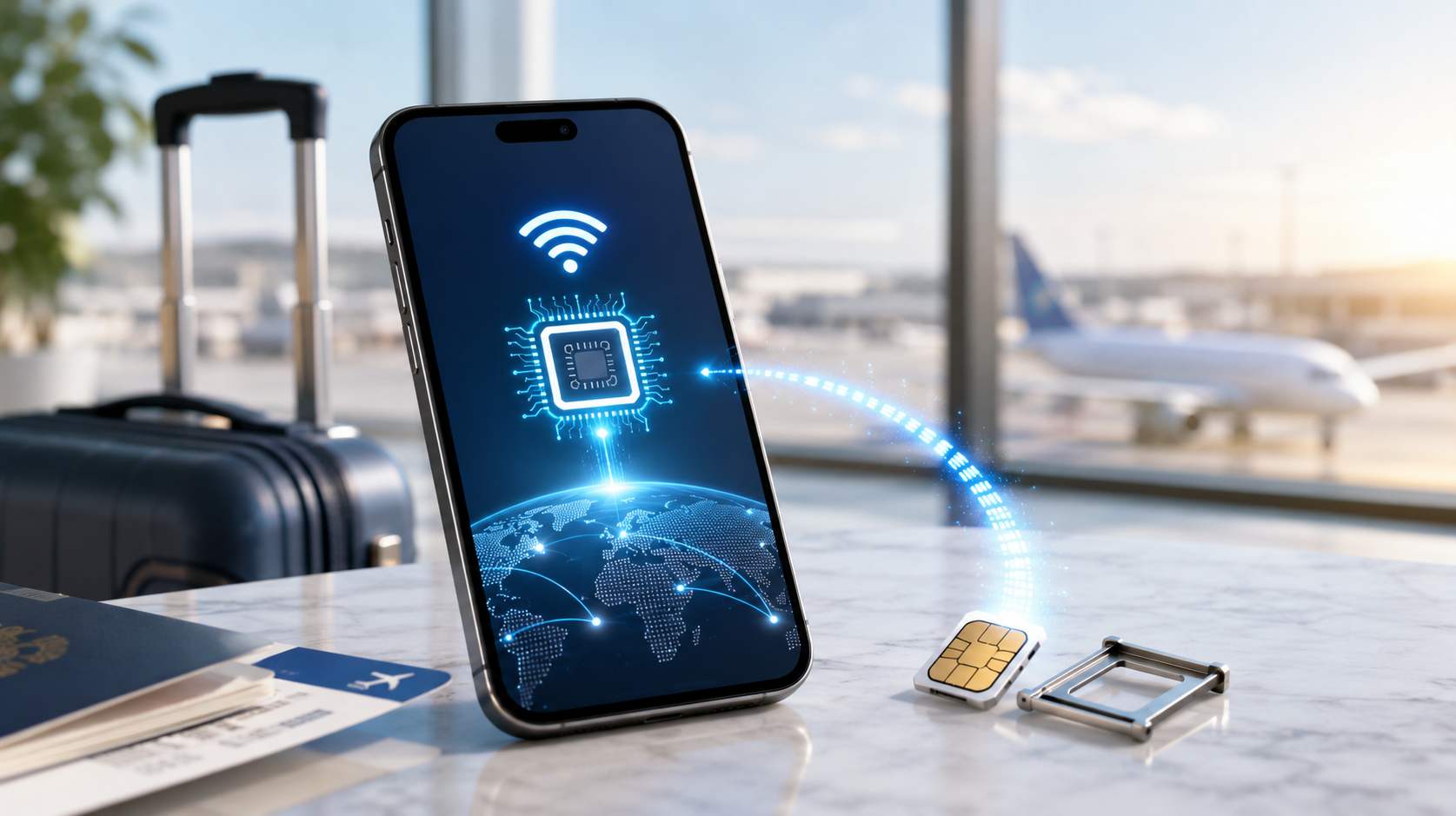
An eSIM is a digital SIM card built into your phone, tablet, or smartwatch instead of a removable plastic chip. The technology arrived in 2016, hit consumer phones in 2017, and now ships in every iPhone since the XS plus most Samsung Galaxy and Google Pixel models. You activate it by scanning a QR code, switching plans takes about two minutes, and most devices hold up to eight profiles at once. Travel eSIMs from providers like Vesim start at $2 and cover 220+ countries. This guide walks through what an eSIM is, how it works, which phones support it, and how to install one.
What is an eSIM?
eSIM stands for embedded Subscriber Identity Module. The chip sits soldered to your phone's motherboard at the factory, which means no plastic tray to pop open and no tiny card to lose. The hardware itself is called an eUICC (embedded Universal Integrated Circuit Card), and it can store software profiles for several carriers at the same time.
A SIM identifies you to a mobile network. Without one, your phone can't connect to cellular service. Physical SIMs do the same job, but their data sits on a removable card you swap manually. With an embedded SIM, the carrier writes that identity data to the chip over the internet using a QR code or activation link.
eSIMs follow the GSMA standard (specification SGP.22 for consumer phones), so any compliant carrier can provision a plan to any compliant device. That's what makes travel eSIMs work. You can buy a plan from a provider in Estonia, install it on a phone bought in Canada, and use it across Thailand without changing anything physically.
Apple was the first major brand to ship a consumer device with an embedded SIM, the Apple Watch Series 3, in 2017.
How does an eSIM work?
Working underneath the surface, an eSIM downloads a carrier profile to the embedded chip and authenticates against the network the same way a physical SIM would. The chip has a permanent EID (eUICC identifier) burned in at the factory. When you buy a plan, the carrier's provisioning service uses that EID to send you a profile containing your ICCID, IMSI, and authentication keys.
Once the profile installs, your phone treats it exactly like a physical SIM. You can call, text, use data, and roam internationally. The phone connects to towers using the same encrypted handshake as plastic cards, defined by the ISO/IEC 7816 standard.
Three steps complete the loop:
Buy a plan. Pick a destination, choose a data amount, pay online.
Receive a QR code. Most providers email it or display it in their app.
Scan and install. Open Settings, scan the code, the profile downloads in under a minute.
You can keep multiple profiles installed on one device. iPhone 17 stores up to eight eSIMs with two running at the same time. Android phones vary by model, but most flagships allow at least two. So you can travel between countries and switch profiles when you cross a border, without removing or buying anything physical.
The profile data lives on the chip, not in the cloud, so once installed you don't need internet for the eSIM to keep working. You only need internet for the initial download.
eSIM vs physical SIM card: what's different?
Physical SIM and embedded SIM serve the same function. The difference sits in the form factor and how you load the credentials.
Feature
Physical SIM
eSIM
Form
Removable plastic chip
Built into the device
Swap method
Pop tray, insert card
Scan QR code, download profile
Profiles per device
One at a time
Up to eight stored
Loss risk
Falls out, gets damaged
Can't be physically removed
Travel swap
Buy local SIM at airport
Buy plan online before departure
Setup time
Insert, reboot, wait
About two minutes
Plastic SIMs still exist on most non-US iPhones and many budget Android models, but the trend runs one way. Apple removed the tray entirely on US iPhone 14 in 2022 and extended that to the iPhone Air in 2025. Carriers in the UK, UAE, and Singapore now ship most new contracts with an embedded profile by default.
Benefits of using an eSIM
Switching to an embedded profile gives you a handful of practical advantages physical cards can't match.
No more lost SIM cards. The chip sits inside your phone, so you can't drop it, forget it in an old device, or have it stolen separately.
Faster carrier switching. Changing networks takes a QR scan instead of a store visit. Move providers in under five minutes.
Multiple numbers, one phone. Run a work line and personal line on the same device. Both numbers ring, both send texts, both bill separately.
Cheaper travel. Travel eSIMs avoid roaming fees. A 5GB plan for Saudi Arabia from Vesim costs around $8 to $12, against $50 to $100 in roaming charges from a home carrier on the same trip.
No store visit. Buy and install from anywhere with Wi-Fi. Useful when you're at an airport or already in transit.
Better resale handling. A phone with an embedded chip has nothing to remove before selling, but the eSIM profile can be wiped digitally in 30 seconds before handover.
The trade-off is internet dependence at install time. You need Wi-Fi or a working cellular signal on a separate SIM to download the profile the first time. After install, it works offline like any other SIM.
Compatible devices: which phones support eSIM?
eSIM support depends on the device. Most flagship phones released after 2018 include the chip, but availability varies by region and carrier lock.
iPhones with eSIM:
iPhone XS, XR, and every iPhone after (2018 onward)
iPhone 14, 15, 16, 17 sold in the US: eSIM only, no plastic SIM tray
iPhone Air: eSIM only in every country
iPad Pro (3rd gen) and newer, iPad Air (3rd gen) and newer
Samsung Galaxy with eSIM:
Galaxy S20 series and newer
Galaxy Note 20 and newer
Galaxy Z Fold and Z Flip series
Most Galaxy A-series flagships from 2022 onward
Google Pixel with eSIM:
Pixel 3 and newer
Pixel Fold
Other supported brands:
Motorola Razr (2020 onward)
Sony Xperia 10 III and newer
OnePlus 11 and newer (region-dependent)
Most Huawei flagships from 2019 onward
Before buying a travel plan, confirm two things: your phone supports eSIM, and it's carrier-unlocked. A locked phone bought on a US contract from Verizon or T-Mobile may refuse to install profiles from other providers. Ask your carrier to unlock it before you install a travel plan.
How to install and activate an eSIM
Installing an embedded profile on a phone takes about two minutes. You need three things: an eSIM-ready phone, a carrier-unlocked device, and a Wi-Fi connection.
iPhone setup
Open the Settings app.
Tap Cellular (or Mobile Data in some regions).
Tap Add eSIM or Add Cellular Plan.
Choose Use QR Code and scan the code from your provider's email.
Confirm the plan label (work, personal, travel) and pick which line uses data.
If your carrier supports eSIM Quick Transfer, you can also pull a profile across from your old iPhone without a QR code.
Android setup (Samsung, Pixel, others)
Open Settings.
Tap Connections or Network & Internet.
Tap SIM Manager or SIMs.
Tap Add eSIM and scan the QR code.
Label the line and set it as primary or secondary.
Activation runs over Wi-Fi. The phone contacts the provisioning server, downloads the profile, and registers with the network. You'll see signal bars within 30 seconds of finishing setup.
For travel plans, install before you fly. Most providers, including Vesim, let you install in advance and activate when you land. That avoids the airport Wi-Fi scramble.
eSIM security: is it safer than a physical SIM?
Security on an embedded SIM beats a removable card on most measures. The chip can't be popped out, so SIM-swap attacks become much harder. Even if the phone is stolen, the profile usually requires biometric or passcode approval before transfer.
The FCC notes embedded SIMs reduce port-out fraud risk because the profile sits inside the locked device. Most carriers add SIM Protection too, which blocks transfers unless you confirm them.
Two practical steps protect your profile further:
Turn on SIM Protection in your carrier's app.
Use two-factor authentication on accounts tied to your phone number, but prefer authenticator apps over SMS where possible.
Wipe the profile before selling or recycling the phone. On iPhone, go to Settings, Cellular, tap the plan, Remove eSIM. On Android the path is Settings, SIM Manager, select the profile, Delete.
Can I have two phone numbers on one phone with eSIM?
Yes. Most eSIM-compatible phones run two lines at the same time. That's either one physical SIM plus one eSIM, or two embedded profiles active together. iPhone 13 and later support two active eSIMs simultaneously. You can route calls and texts through either line and set one as default for data.
Does an eSIM work with 5G?
Yes, eSIM supports 5G on any device that supports 5G hardware. The profile is just the identity layer, not the radio. If your phone has a 5G modem and your plan includes 5G access, the eSIM connects at 5G speeds. Vesim plans include 5G in countries where the local network supports it, including UAE, Saudi Arabia, USA, and UK.
Can I use one eSIM in multiple countries?
Yes, regional and global plans cover multiple countries on a single profile. A regional Europe plan covers 30+ countries. A global plan from Vesim covers 220+ destinations. Local plans are cheaper per gigabyte but only work in one country, so the right choice depends on your trip length and number of stops.
Do I need to remove my physical SIM before installing an eSIM?
No, both can coexist on Dual SIM phones. Keep your home carrier SIM active for incoming calls and WhatsApp, and use the travel profile for data abroad. This is the most common setup for international trips, since it preserves your home number while killing roaming costs.
How long does eSIM activation take?
Two to five minutes from QR scan to first connection. You need Wi-Fi for the initial download. After install, the profile works offline like any normal SIM. If activation hangs, restart the phone and check your provider's app for the install code.
Can I transfer an eSIM to a new phone?
Sometimes, depending on the carrier. Apple supports eSIM Quick Transfer between iPhones, which moves the profile in about a minute. Android transfers depend on the provider: some allow it through their app, others require a fresh QR code from support. Travel profiles from most providers are tied to one device, so plan on installing a new one if you change phones mid-trip.
Is an eSIM cheaper than roaming?
Yes. Travel eSIMs typically cost 60% to 90% less than carrier roaming. A 10GB plan for Thailand from a travel provider costs around $12. The same usage on a US carrier's day pass would run $120 across 12 days. The savings grow with longer trips and heavier data use.
What happens to my eSIM if I lose my phone?
Contact your carrier or eSIM provider straight away to suspend the profile. They can block it remotely, which stops anyone from using your data plan. Because the chip can't be removed, lost phones with embedded profiles are less useful to thieves than ones with physical cards. Buying a Vesim plan again on a replacement phone takes about three minutes.
Which countries does Vesim cover?
Vesim covers 220+ countries, including high-traffic destinations like the USA, UK, UAE, Saudi Arabia, Turkey, Singapore, Japan, Canada, France, Thailand, and Malaysia. Plans start at $2 and include local, regional, and global options for trips of any length.