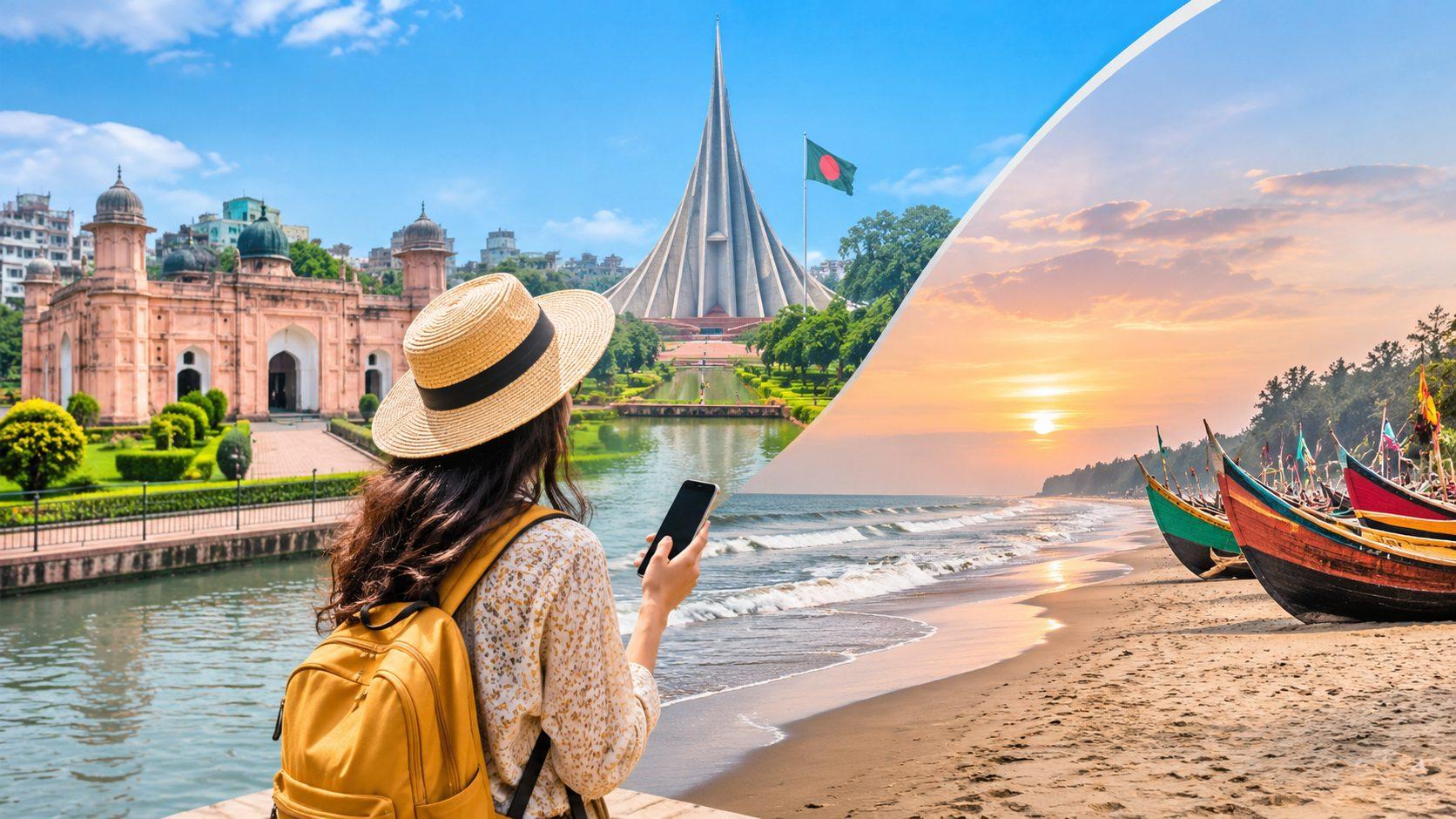
Best eSIM for Bangladesh: Dhaka & Cox's Bazar
An eSIM for Bangladesh is a digital SIM that loads Bangladeshi mobile data onto your phone with no plastic card. You install it at home and turn it on at Dhaka airport. Vesim lists Bangladesh plans from $2, so ride apps, maps and family calls work before you leave arrivals.
Bangladesh has four mobile networks: Grameenphone, Robi, Banglalink and Teletalk. Grameenphone is the largest and has the widest reach. Robi also runs the Airtel brand, and Teletalk is state owned. 4G covers Dhaka, Chattogram, Sylhet, Cox's Bazar and most towns, while 5G remains limited.
Local SIMs in Bangladesh need biometric registration. Shops scan your fingerprint and passport before the line goes live. A travel eSIM skips that step and keeps your home SIM active for bank texts.
Dhaka has solid 4G across Gulshan, Banani, Dhanmondi and the Metro Rail line. Old Dhaka's narrow lanes and the Sadarghat river port get busy, which can slow speeds. Ride apps like Pathao and Uber need data for every trip.
Cox's Bazar sits on one of the world's longest natural sea beaches, about 120 km of sand. The town and main beach points have good 4G. Marine Drive toward Inani and Teknaf holds a signal for most of the way. The Sundarbans and remote tea gardens have weaker coverage.
Many visitors are family coming home from the UK, the Gulf or North America. Most use about 1 to 2 GB a day.
Why an eSIM for Bangladesh saves time on arrival
An eSIM for Bangladesh saves you the biometric SIM registration at the airport. Local SIM sellers must scan your fingerprint and passport by law. Queues and paperwork can take a while after a long flight. A travel eSIM connects on landing, and your home number stays active.
The usual choices compare like this:
Home roaming: easy, but daily fees from UK, Gulf and US carriers add up fast.
Local SIM: cheap data, but you register with fingerprints and pull out your home SIM.
Family Wi-Fi: free at home, but no help in traffic, at markets or on day trips.
Travel eSIM: local data on arrival, with no registration and no card swap.
Your home SIM matters for banking and work. One time codes still reach your home number by text. Turn off data roaming on that line to avoid charges. Then all data runs through the eSIM.
Long trips home for Eid or weddings often run two to four weeks. A travel plan sized for that stay keeps costs steady. You avoid surprise bills from home roaming.
Your plan then connects through one of four local networks.
Bangladesh's mobile networks: Grameenphone, Robi, Banglalink and Teletalk
Bangladesh has four mobile networks: Grameenphone, Robi, Banglalink and Teletalk. Grameenphone has the most users and the widest coverage. Robi and Banglalink cover cities and main roads well. Teletalk is state owned and smaller. A travel eSIM connects through one or more of these networks as partners.
Each network has its own footprint:
Grameenphone: the market leader, with the broadest 4G reach in towns and villages.
Robi: strong in cities, and it also runs the Airtel brand after a merger.
Banglalink: good urban coverage with a growing rural network.
Teletalk: the state owned operator, smaller but present in many districts.
You don't pick the network when you buy a travel plan. The provider sets up partner deals, and your phone joins the strongest signal. The network name appears in your status bar once you connect.
Plans with more than one Bangladeshi partner give you a backup. That helps in villages and on long road trips, where one network may be much stronger than another.
Dhaka is where most trips start.
Dhaka coverage: airport, Metro Rail and Old Dhaka
Dhaka has solid 4G across Gulshan, Banani, Dhanmondi, Uttara and the city center. Hazrat Shahjalal International Airport gets good signal at arrivals. The Dhaka Metro Rail line keeps coverage at stations. Old Dhaka's crowded lanes can slow speeds, but data stays usable for maps and messages.
Your phone helps with a lot in Dhaka:
Rides: Pathao and Uber offer cars and motorbikes with fares shown up front.
Traffic: live maps show jams, which can turn a short trip into an hour.
Metro Rail: the line from Uttara through the center skips much of the road traffic.
Food: delivery apps bring meals to homes and hotels across the city.
Traffic shapes every plan in Dhaka. A ride from the airport to Gulshan can take 30 minutes or two hours. Check live maps before you set off, and leave buffer time for flights and events.
Gulshan and Banani hold most embassies, offices and upscale hotels. Coverage there is strong, and cafés offer Wi-Fi for remote work. Dhanmondi, near the lake, mixes homes, schools and restaurants with steady signal.
Old Dhaka rewards a slow visit. Lalbagh Fort, Ahsan Manzil and the Armenian Church sit close together. Rickshaws work better than cars in the narrow lanes, and maps help you find your way back.
Sadarghat, the river terminal, gets crowded and loud. Keep your phone secure and save your route before you go.
Eid changes the city. Millions travel home in the days before the holiday, so buses, trains and flights sell out. Book tickets early and track them in apps. Networks also get busy in crowded areas, so expect slower speeds at peak times.
Many visitors then head south to the coast.
Cox's Bazar coverage: beach, Marine Drive and Inani
Cox's Bazar has good 4G across town and the main beach points, including Laboni, Sugandha and Kolatoli. Domestic flights from Dhaka take about an hour, and a direct train also runs. Marine Drive toward Inani and Teknaf keeps signal on most stretches. Remote spots near the border have weaker coverage.
Key spots and what to expect:
Laboni and Sugandha beach points: strong signal for photos, calls and video.
Kolatoli: the hotel strip has fast coverage and busy evenings.
Himchari: the hills and waterfall have decent signal at the viewpoint.
Inani Beach: rocky shore about 25 km south, with good signal near the main area.
Teknaf: the far southern town has coverage, but border areas are quieter.
The train from Dhaka to Cox's Bazar runs overnight or during the day. Coverage holds in towns along the route. Rural stretches have short gaps, so download shows before you board.
Saint Martin's Island, off the coast, has seasonal limits on visitors. Check the current rules before you plan a trip. Coverage on the island stays thin.
Sunset draws big crowds to the beach points each evening. Thousands of phones share the same towers. Speeds can slow for an hour, then recover after dark.
Hotels in Cox's Bazar offer Wi-Fi, but beach days rely on mobile data. Hotel booking apps and beach photo uploads add up fast.
Coverage beyond Dhaka and Cox's Bazar
Coverage outside the two main hubs is good in towns and weaker in forests and river areas. Sylhet and Srimangal have solid 4G in town. Tea gardens and hill areas are quieter. The Sundarbans has little coverage beyond the edge towns.
Towns stay strong, while forests and rivers need offline backups.
Sylhet is home to many UK families. The city has good coverage, and the Shahjalal shrine area stays connected. Srimangal, the tea capital, has solid signal in town and patchy coverage among the gardens.
The Sundarbans mangrove forest is a boat trip from Khulna or Mongla. Tours run for one to three days. Expect little or no signal once you enter the forest. Let family know your plans before you go.
Intercity trains link Dhaka with Chattogram, Sylhet and Khulna. Coverage holds near towns along each line, with quiet stretches through farmland. Buy seats early in the rail app, since popular trains fill fast.
Chattogram is the second largest city and the gateway to the Hill Tracts. Coverage is good in the city. Hill areas have weaker signal and their own travel rules for visitors.
Visiting family: home number, WhatsApp and imo
Many travelers to Bangladesh are family visiting home, and they need to stay reachable on their usual numbers. A travel eSIM handles data, while your home SIM keeps your number active for texts. WhatsApp and imo keep working on your existing account. Calls home stay free over data.
A few habits keep family visits smooth:
Keep your number: leave your home SIM in the phone and turn off its data roaming.
Keep WhatsApp: your account stays tied to your home number, even on a travel data line.
Use imo: many relatives in Bangladesh use imo for video calls, and it runs on any data line.
Share data: if your plan allows hotspot use, you can share data with a parent's tablet.
The guide to keeping your WhatsApp number on a travel eSIM explains why your account doesn't change. You don't need to verify anything new.
Mobile money is the one gap. bKash and Nagad need a local number and ID. Most visitors use cash or ask a relative to pay by mobile money when needed.
Long visits also mean more data. Video calls with family abroad, wedding photos and social posts add up. Size your plan for the full stay.
Bangladesh with India and Pakistan
Bangladesh, India and Pakistan each run their own mobile networks, so a Bangladesh plan won't work across borders. Many travelers combine trips to visit family or for business. Install a plan for each country at home, then switch your data line when you land. A regional plan may also cover several.
These guides cover the neighbors:
The Pakistan eSIM guide explains how eSIMs work there and what to check.
The India eSIM guide covers plans and coverage in major Indian cities.
Two eSIMs on one phone make multi country trips easy. Most modern phones hold several profiles. You only switch which one handles data.
Near the India border in places like Sylhet, your phone may pick up an Indian network. If data stops, open your network settings. Turn off automatic selection and choose a Bangladeshi network.
How much data you need in Bangladesh
Most visitors use about 1 to 2 GB per day in Bangladesh. Ride apps, maps, WhatsApp and social posts stay near 1 GB. Video calls with family, streaming and photo backups push you to 2 GB or more. A two week family visit with normal use fits in about 20 GB.
Daily use usually falls into three bands:
Light use: maps, messages and a few rides, about 500 MB a day.
Normal use: plus social posts and a daily video call, about 1 to 2 GB a day.
Heavy use: plus streaming, wedding videos and cloud backups, 3 GB or more a day.
Video calls are the biggest factor for family trips. A long daily call with relatives abroad can use several hundred megabytes. Use home Wi-Fi for long calls when you can.
Power cuts still happen in some areas, especially in summer. Your phone battery becomes your lifeline when home Wi-Fi goes down. Keep a power bank charged, and your eSIM keeps you online when the router switches off.
Weddings bring lots of photos and video. Set cloud backups to Wi-Fi only so they don't drain your plan in one evening.
How to set up your Bangladesh eSIM before you fly
Set up your Bangladesh eSIM at home on Wi-Fi before departure. Buy the plan, scan the QR code and name the line. Keep it off during the flight. After landing in Dhaka, turn it on, set it for cellular data and switch on data roaming for that line.
Confirm your phone supports eSIM and isn't carrier locked.
Buy a plan on the Vesim Bangladesh eSIM page.
Scan the QR code from another screen, or enter it by hand.
Label the line "Bangladesh data" so you can find it fast.
Turn on the line and data roaming after you land.
Keep your home line for texts, with its data roaming off.
Check your status bar for a Bangladeshi network before you leave the airport. Then open Pathao or Uber to test data.
Which network is best in Bangladesh?
Grameenphone has the widest coverage, especially outside big cities. Robi and Banglalink work well in Dhaka and other towns. For a city and coast trip, any of them serves visitors well.
Do I need biometric registration for an eSIM?
No, a travel eSIM doesn't need biometric registration. Local SIMs do, with your fingerprint and passport. That's a key reason many visitors choose an eSIM.
Does my eSIM work in Cox's Bazar?
Yes, it works across Cox's Bazar town and the main beach points. Marine Drive keeps signal on most stretches. Remote areas near the border have weaker coverage.
Can I keep my WhatsApp number in Bangladesh?
Yes, your WhatsApp account stays on your home number. The eSIM only provides data. Calls and chats work the same as at home.
Is there 5G in Bangladesh?
5G is very limited in Bangladesh. Most of the country runs on 4G. That handles maps, video calls and social apps well.
Can I use bKash with a travel eSIM?
No, bKash needs a local number and ID. A travel eSIM is data only for most plans. Cash and cards cover most visitor spending.
Does my eSIM work in the Sundarbans?
Coverage works in edge towns like Mongla, but it fades inside the forest. Boat tours often run for days with little signal. Tell family your plans before you go.
How much does an eSIM for Bangladesh cost?
Vesim lists Bangladesh plans from $2. Larger data sizes and longer validity cost more. Check the country page for current options.
Your Bangladesh data plan in short
Bangladesh's four networks, Grameenphone, Robi, Banglalink and Teletalk, give visitors 4G across Dhaka, Cox's Bazar and most towns. A travel eSIM skips biometric registration and keeps your home number for texts, WhatsApp and imo. Old Dhaka traffic, Marine Drive and Sylhet all stay connected, while the Sundarbans needs offline planning.
Plan on 1 to 2 GB a day and size up for long family visits. Set up the line at home and switch it on in Dhaka. Then your eSIM for Bangladesh keeps you close to family from the first hour.