eSIM vs Soft SIM vs Cloud SIM: Differences Explained
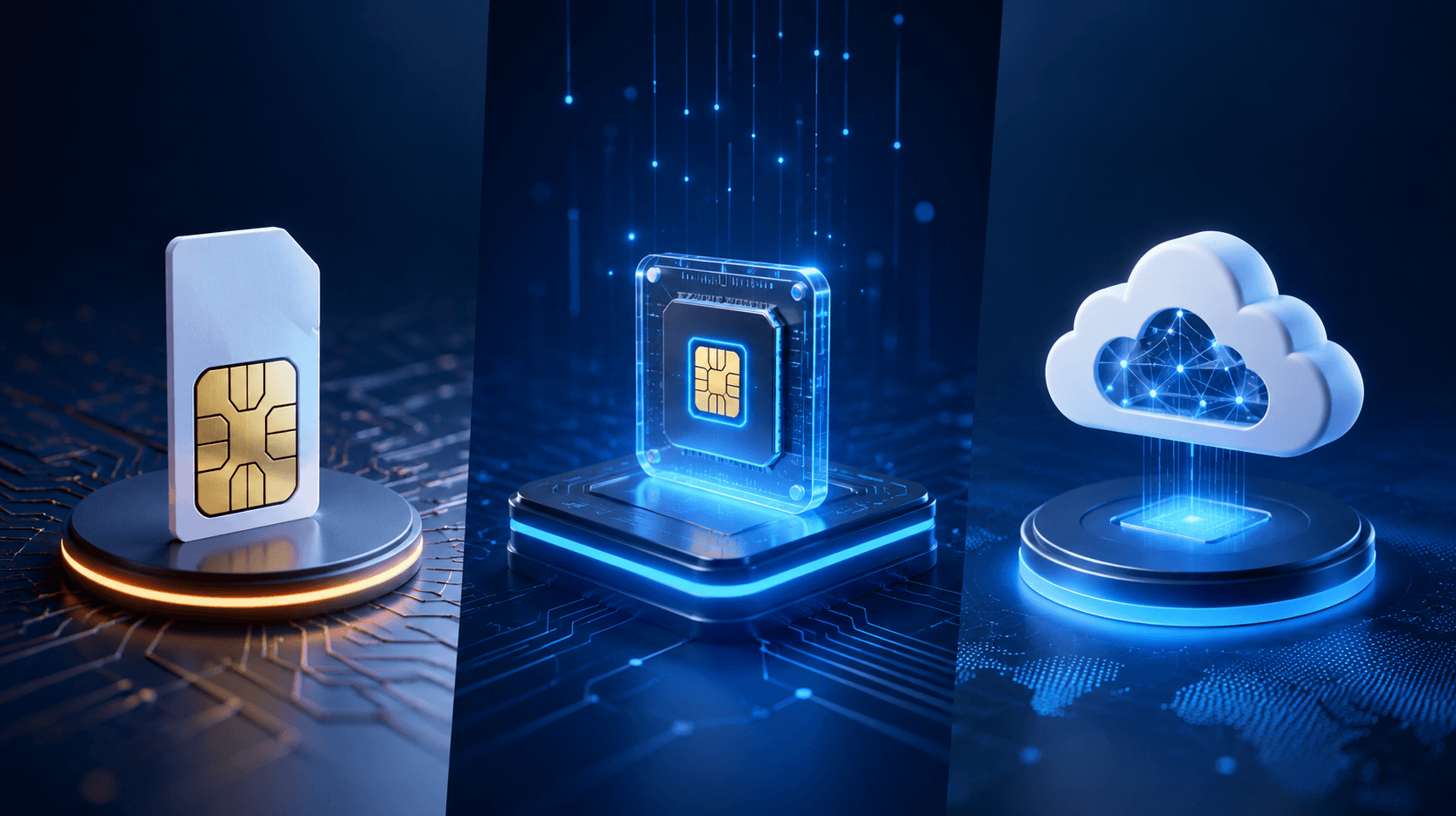
All three drop the plastic SIM card, but they are not the same technology. An eSIM is a real chip soldered into your phone that downloads carrier profiles over the air. A Soft SIM has no chip at all, the SIM exists purely as software in the device's memory. A Cloud SIM keeps the network profiles on a remote server and hands one to your device on demand, usually to chase the best local signal. The differences come down to where the SIM "lives" and how secure it is.
Here is what separates them, why the security gap matters, and where you actually meet each one.
A quick note on the names
The terminology is messy, so it helps to settle it first. "Soft SIM" and "Cloud SIM" are sometimes used as synonyms for the same idea: a SIM with no physical hardware at all. But in everyday travel use, "Cloud SIM" more often describes a specific approach where network identities sit on a server and get pushed to a device to switch between carriers, the technology behind many pocket WiFi routers and travel hotspots. This guide treats them as distinct because, in practice, that is how people encounter them. Where they overlap, it is called out.
eSIM: a chip that downloads its profile
An eSIM (embedded SIM) is a small chip built into the device during manufacturing, soldered to the circuit board and not removable. In industrial form it is known as MFF2. It does the same job as a plastic SIM, but instead of carrying one fixed carrier, it uses eUICC technology and Remote SIM Provisioning to download and store carrier profiles over the air.
That is what lets you scan a QR code, install a travel plan, and switch networks without swapping anything physical. Modern phones can hold several eSIM profiles and keep one or two active at once. Because the chip is a certified piece of hardware, it carries a built-in security layer that software alone cannot match. This is the format in nearly every recent iPhone, Samsung Galaxy, and Google Pixel, and the one travel eSIM providers sell to tourists.
Soft SIM: no hardware at all
A Soft SIM (software SIM) removes the SIM hardware completely. There is no chip, embedded or otherwise. The SIM is a software program running on the device's existing processor or cellular module, with all the credentials stored in the device's memory rather than a dedicated secure chip.
Functionally it behaves like any SIM. It handles the same authentication commands (the APDU messages a SIM exchanges with the device) and follows GSMA interface guidelines, so the phone or module treats it as a normal SIM for calls, texts, and data. The first fully software IoT SIM only launched in 2023, which tells you how new this is. Soft SIM is aimed mainly at IoT and embedded devices, not consumer phones, where it promises maximum space saving and no hardware to damage with dust or water.
The trade-off is security and standards. Because the credentials live in general device memory rather than a certified secure element, a Soft SIM is more exposed to tampering and hacking, and the format is not yet regulated to the same standard as eSIM. The GSMA, the mobile industry's standards body, explicitly separates Soft SIM from eSIM and iSIM, noting that embedded formats always keep a physical hardware element that adds an indispensable security layer. Tier 1 carriers rarely enable Soft SIM for that reason.
Cloud SIM: profiles served from the network
A Cloud SIM stores the network identities remotely and assigns one to your device when it connects. In the travel sense, this almost always means multi-IMSI technology. An IMSI is the unique number that identifies you to a mobile network; a normal SIM holds one, tying you to a single home carrier and whatever roaming deals it has. A Cloud SIM device draws from a pool of many IMSIs, picking the best local network wherever you are.
The practical payoff is coverage and cost. When the device lands in a new country, the system allocates an IMSI for a strong local carrier, so it connects more like a local subscriber than a roamer, often with better speed and lower cost. If a signal drops or weakens, it can switch to another network in the background. That is why Cloud SIM powers so many pocket WiFi routers and global travel hotspots: one device, many countries, no swapping.
The downsides mirror Soft SIM. The approach lacks universal standards, which can cause compatibility quirks across devices and regions, and the security of a software-based endpoint is hard to certify even when the cloud service itself is well protected. A system is only as secure as its weakest link, and that link is usually the device end.
Side-by-side comparison
Feature
eSIM
Soft SIM
Cloud SIM
Physical hardware
Embedded chip (soldered, non-removable)
None
None on device; profiles on remote server
Where the profile lives
On the eUICC chip
In device memory or module
On a server, allocated to the device
Carrier switching
Over the air, via Remote SIM Provisioning
Over the air (varies by implementation)
Automatic, picks best local IMSI
Security
Hardware-backed, certified
Software only, less certified, more exposed
Cloud secure, but endpoint hard to certify
Standards
GSMA-standardised
Not yet regulated to eSIM level
No universal standard
Main use today
Consumer phones, tablets, travel plans
IoT and embedded devices
Travel routers, pocket WiFi, IoT fleets
First appeared
Around 2016 for consumers
First fully software IoT SIM in 2023
Established in travel-router and IoT use
Which one are you actually using?
For almost any traveller with a recent phone, the answer is eSIM. It is the format behind the QR-code travel plans you buy, the dual-SIM setup that keeps your home number live, and the network switching you do in settings. It is also the most secure of the three because the chip is certified hardware.
Soft SIM is something you are far more likely to find inside an IoT product, a sensor, a tracker, an embedded module, than in your pocket. It matters if you build or manage connected devices; it rarely matters when you are booking a holiday.
Cloud SIM shows up when you rent or buy a pocket WiFi device or a global travel router. If you have used one of those hotspots that "just works" across dozens of countries, a multi-IMSI Cloud SIM was doing the network-hopping behind the scenes.
The bottom line
The real divide is hardware versus software. eSIM keeps a certified chip in the device, which is why it dominates consumer phones and carries the strongest security. Soft SIM throws out the hardware entirely and lives in software, which makes it flexible for IoT but harder to secure and not yet fully standardised. Cloud SIM moves the profiles off the device and onto a server, trading some security certainty for seamless multi-country coverage, ideal for travel routers and connected fleets. For a phone and a trip, eSIM is the one you want.