Best eSIM for Singapore: Tourist Data Plans 2026
A travel eSIM is the fastest way to stay connected in Singapore, because you install it before you fly and walk off the plane at Changi already online. No airport kiosk, no ID check, no swapping a physical card. Vesim covers Singapore inside its 220+ country range, activates in seconds with no physical SIM, and starts from $0.60, so you can book a Grab from the taxi rank or pull up the MRT map before you even reach baggage claim. Singapore runs on speed. It carries one of the world's fastest mobile networks, 5G blankets the tourist core, and an eSIM lets you tap that network the moment you land. This guide covers how eSIM coverage performs across the city-state, which Singapore network gives the best signal, how much data a typical 4-to-5-day trip needs, whether your phone supports eSIM, the Singapore-plus-Malaysia regional question, and how to set everything up before departure.
Why choose an eSIM over roaming or a local SIM
Roaming is the expensive default most travellers fall into without thinking. Your home carrier switches on international roaming the second you land, and the daily fee adds up fast across a trip. A Singapore travel eSIM runs on local network rates instead, which works out far cheaper, and it shows you a flat price up front rather than a surprise on next month's bill. You keep your home number reachable on its own line while the eSIM carries the data.
A local SIM card avoids the roaming bill but trades it for friction. You queue at a Changi counter or a phone shop, show your passport, and swap out your physical SIM, which means juggling the tiny card and risking losing it. None of that is necessary with an eSIM. You buy online, scan a QR code, and the profile installs without a store visit or an ID check.
The eSIM also wins on timing, which matters more in Singapore than almost anywhere. This is a city where Changi's efficiency and the MRT's clockwork timings set the pace, and being offline for even a few minutes feels out of step. Booking a ride, checking into a hotel, or loading directions all want a live connection the instant you arrive. With a Vesim profile installed before you fly, you have exactly that. The next thing worth understanding is the network your data actually rides on.
Which Singapore network gives the best coverage
Singapore runs on three mobile networks, and all three are strong. Singtel, StarHub, and M1 cover the entire island with dense 4G and widespread 5G, which is a different situation from sprawling countries where coverage thins out between cities. Here the whole country is effectively one connected metro area, so you get reliable signal almost everywhere you go.
Singtel sits at the top for most travellers. It tends to lead on speed and reliability, and its coverage reaches consistently from Sentosa across to the Singapore Zoo and out to the residential edges. StarHub-based plans often come in cheaper while still delivering solid performance, and M1 rounds out the trio. For a tourist, the practical point is that you do not need to agonise over the network the way you would in a country with patchy rural towers. Any plan on a strong local network will serve you well across the island.
A travel eSIM connects to this local infrastructure rather than charging you home-carrier roaming rates. Vesim runs on Singapore's local networks, so your data moves at local speed across the city. Because the island is so compact and so heavily built out, the coverage question that dominates other destinations barely registers here. What does matter is whether you have 5G, since that is where Singapore's network really shows off.
5G coverage and where it works
Singapore has one of the most advanced mobile networks on the planet, and 5G is widely available across the tourist areas. Testers report solid 5G in central and touristy spots like Marina Bay and Sentosa, with the signal easing back to fast LTE only in more outlying or rural pockets. For practical purposes, anywhere a visitor is likely to spend time carries high-speed data.
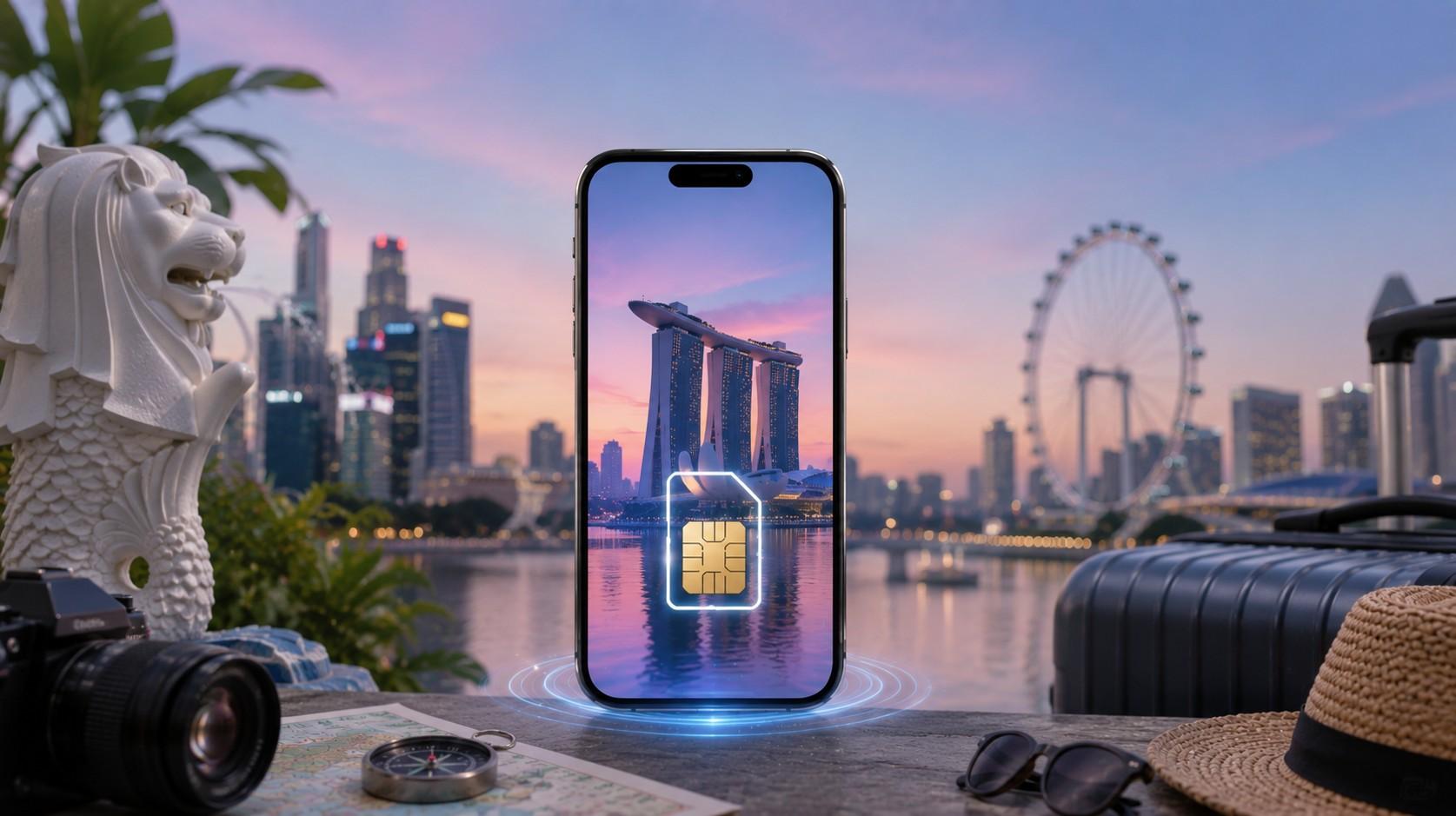
That speed changes what your phone can do on the move. Marina Bay Sands, the Rain Vortex at Jewel Changi, and Merlion Park all look sharp in 4K video, and a 5G connection lets you upload and share them instantly rather than waiting for hotel Wi-Fi. Streaming, video calls, and large photo uploads all run smoothly on the move, so you are not rationing your connection around the day.
To use 5G you need two things to line up: a plan that supports it and a phone that does. Vesim data plans are built for Singapore's fast networks, so the plan side is covered. The phone side comes down to your device, which is the next thing to check before you buy anything. You can size and pick a 5G-ready plan from the Vesim Singapore page once you have confirmed your handset works.
Will your phone work with a Singapore eSIM?
eSIM support comes down to two requirements, and both are easy to check before you travel. Your phone must be eSIM-compatible and it must be carrier-unlocked. A locked phone tied to your home carrier will not accept a travel eSIM, so confirm the lock status with your provider if you bought the handset on a contract.
Most recent phones clear the bar comfortably. Newer iPhones, Google Pixel models, and a wide range of current Samsung and other Android flagships all support eSIM, and the feature has been standard on premium phones for several years now. The quickest check on an iPhone is to look for an "Add eSIM" or "Add Cellular Plan" option in the cellular settings; on Android, look under the SIM manager. If the option is there and the phone is unlocked, you are ready.
Worth doing this check before you buy a plan rather than after you land. An eSIM is non-physical, so there is nothing to return or swap if your phone turns out not to support it, and confirming compatibility up front saves the headache. Once you know your phone is good, the next decision is how much data to buy, which depends on how you travel.
How much data do you need for a Singapore trip?
Data needs scale with trip length and habits, and Singapore trips have a recognisable shape. Many visits run 4 to 5 days, often as a stopover or a short city break, which makes a mid-sized plan the common sweet spot. As a rough guide, light users who mostly message and navigate manage on 1GB to 5GB, the typical short-trip tourist sits comfortably around 5GB to 10GB, and heavy users, digital nomads, or anyone working from the hotel each evening should look at 10GB or more, up to unlimited.
Singapore nudges data use upward in a few predictable ways. You will lean on Google Maps and the MRT app to move around, book Grab rides, and share photos from the obvious landmarks, all of which add up across a day of sightseeing. If you are streaming in the evenings or hotspotting a laptop to work, that pushes you toward the larger allowances, so confirm tethering is supported on your plan before relying on it.
Vesim offers flexible Singapore plans starting from $0.60, which means you can match the allowance to the actual trip rather than overbuying for a long weekend. A two-day layover, a five-day holiday, and a two-week work stay are three different data profiles, and you can pick the right size on the Vesim plans page. If Singapore is only one stop on a wider Asia trip, there is a further option worth weighing.
Singapore and Malaysia: regional plan or local plan?
Many Singapore trips pair with a hop across the causeway to Malaysia or a wider Southeast Asia loop, and that changes the maths. A local Singapore-only plan gives you the best value if you are staying put in the city-state, since you pay only for the coverage you use. The moment your itinerary crosses a border, though, a single-country plan stops working at the frontier and you would need to buy a second one.
A regional eSIM solves that by covering multiple countries on one profile. If you are doing Singapore plus Kuala Lumpur, or threading through several Southeast Asian stops, a regional plan keeps you connected across all of them without buying and switching profiles at each border. You install once and stay online through the whole route.
The right choice comes down to your map. Singapore only, or Singapore as a base you return to, points toward a local plan for the sharpest price. A genuine multi-country itinerary points toward regional coverage for the convenience of one profile across borders. Vesim covers both Singapore and the wider region across its 220-country footprint, so either way you can match the plan to the trip from a single provider. Whichever you pick, the setup runs the same way.
How to set up your Singapore eSIM
Setup happens at home before you fly, while you still have stable Wi-Fi. Buy the Vesim plan, then install the profile by scanning the QR code or activating through the app. The eSIM installs as a second line that sits dormant until you switch it on, so you can set it up days ahead with no rush. The whole install takes seconds and adds nothing physical to your phone.
Two settings do the real work once the profile is in. Before you arrive, open your mobile data settings and set the Vesim eSIM as your default data line. Then turn off data roaming on your primary SIM. That combination forces every app to pull data through the local Singapore eSIM and stops your home line quietly racking up roaming charges in the background. Keep the home line switched on if you still want it to receive calls and bank codes; it simply will not carry data.
Timing the activation neatly is the last detail. Install before departure, but if your plan's validity starts on activation, wait to switch the data on until you land at Changi so you get the full validity window in-country. From there your phone uses fast local data immediately, and you are online for that first Grab ride or MRT trip into the city. One more thing is worth knowing, since most Singapore travel eSIMs are data-only.
Calls and texts on a data-only eSIM
Most travel eSIMs for Singapore, Vesim included, are data-only. A data-only plan provides internet and no local phone number, so it cannot send standard carrier SMS or place ordinary cellular calls. This is the norm across the eSIM market and rarely an issue in a connected city like Singapore, where almost everything runs over the internet anyway.
Internet calling covers the gap completely. WhatsApp, FaceTime, Telegram, Signal, and Messenger all place voice and video calls over your Vesim data connection at no extra charge, and they keep the identity you already use, so contacts reach you as normal. To dial a regular phone number with no app attached, a VoIP service like Skype calls real numbers over data for a small credit. For booking restaurants, calling a hotel, or reaching a tour operator, app calling handles nearly every situation.
Your home number keeps its job if you leave that line active. Bank one-time passwords and verification texts arrive on your home SIM as carrier SMS, so keeping that line switched on means your 2FA codes still land while the Vesim eSIM handles all your data. That pairing, home line for codes and the eSIM for everything online, is the setup most experienced travellers use. A handful of questions come up repeatedly, so here are direct answers.
What is the best eSIM for Singapore in 2026?
The best eSIM for Singapore is one that rides a strong local network, supports 5G, and matches your trip length. Singtel leads for speed and reliability, with StarHub and M1 close behind, and all three cover the island well. Vesim runs on Singapore's local networks, activates instantly with no physical SIM, and starts from $0.60, which makes it a practical pick for short city breaks and longer stays alike.
Do I need to show ID to buy a Singapore travel eSIM?
No. Unlike a local physical SIM, which involves a counter visit and a passport check, an international travel eSIM needs no ID verification. You buy it online, receive a QR code, and install it through your phone's eSIM settings with no store visit and no waiting. That is one of the main reasons travellers choose an eSIM over an airport SIM card.
How much eSIM data do I need for 4 to 5 days in Singapore?
A typical 4-to-5-day Singapore trip fits comfortably in roughly 5GB to 10GB. That covers daily Google Maps and MRT navigation, Grab rides, messaging, and sharing photos from the landmarks. Light users who mostly message can manage on less, while anyone streaming in the evenings or hotspotting a laptop should size up toward 10GB or an unlimited plan.
Does an eSIM get 5G in Singapore?
Yes, where your phone and plan both support it. Singapore has one of the world's most advanced networks, and 5G is widely available across tourist areas like Marina Bay and Sentosa, easing to fast LTE only in outlying spots. Vesim plans are built for these fast networks, so you need a 5G-capable phone to make the most of the speed.
Will my phone work with a Singapore eSIM?
Your phone must be eSIM-compatible and carrier-unlocked. Most recent iPhones, Google Pixel models, and current Samsung and other Android flagships support eSIM, and the feature has been standard on premium phones for years. Check for an "Add eSIM" option in your cellular settings, and confirm your phone is unlocked with your home carrier before buying a plan.
Can I use one eSIM for both Singapore and Malaysia?
Only with a regional plan. A Singapore-only plan stops at the border, so if your trip includes Malaysia or a wider Southeast Asia loop, choose a regional eSIM that covers multiple countries on one profile. Vesim covers Singapore and the surrounding region across its 220-country footprint, so you can stay online across borders without switching profiles.
When should I activate my Singapore eSIM?
Install the eSIM at home over Wi-Fi before you fly, set it as your default data line, and turn off data roaming on your primary SIM. If your plan's validity begins on activation, wait until you land at Changi to switch the data on so you get the full window in-country. You will be connected the moment you arrive, ready for your first ride or MRT trip.