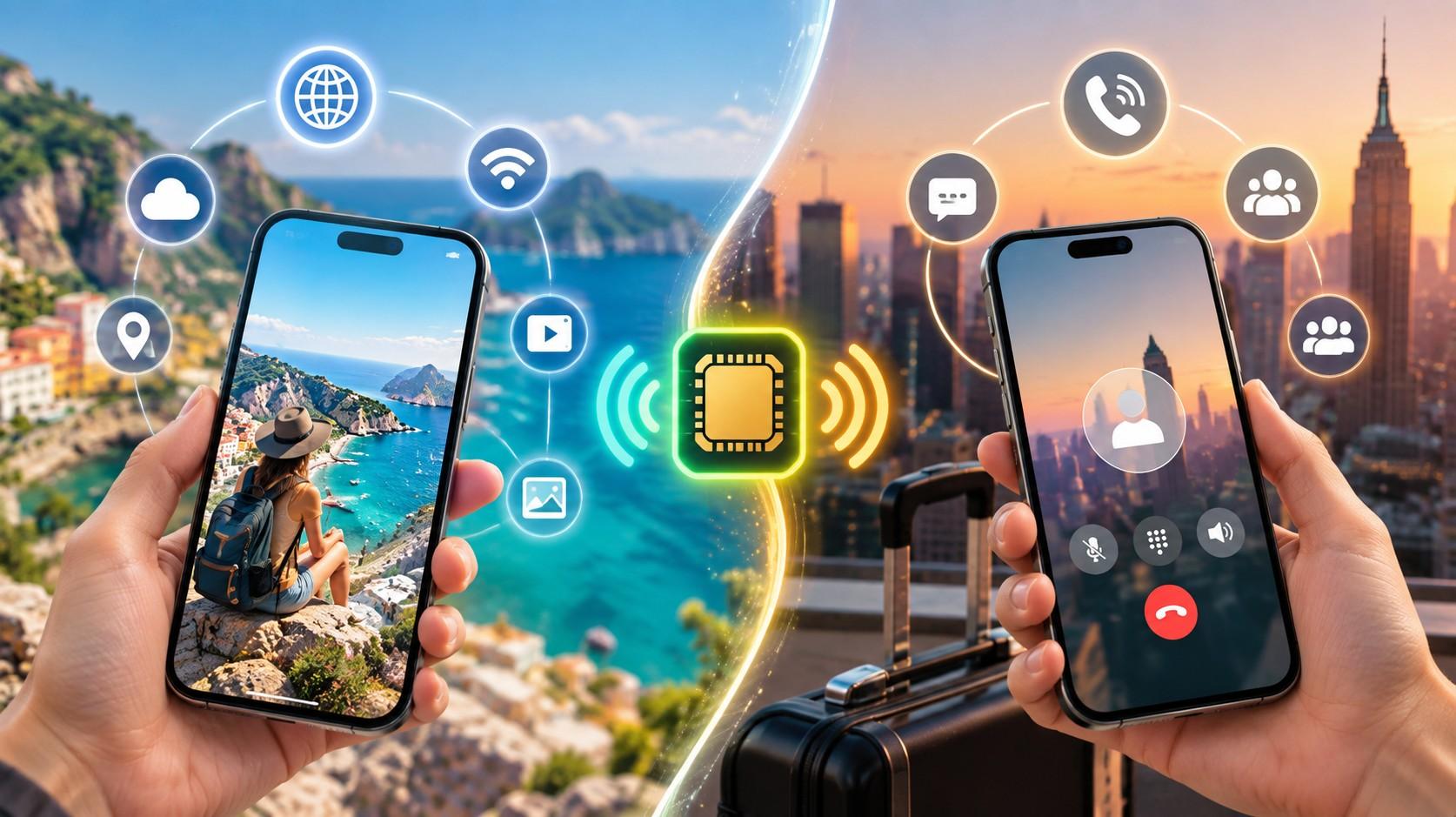
eSIM Data-Only vs Voice + Data Plans Explained
A data-only eSIM is a travel profile that carries mobile data and nothing else, with no phone number attached to it, no cellular calling, and no SMS. A voice and data plan adds a local number, which means the profile can place and receive standard cellular calls and text messages in the destination country.
Most travel plans sold today are data-only, and most travelers never notice. Calls run through WhatsApp, FaceTime, Telegram, Signal, and Zoom, all of which need bandwidth rather than a number. A 1.5 Mbps connection carries a video call comfortably, and messaging apps use a few megabytes an hour. Meanwhile your home SIM sits in the second slot, keeping your own number live for the texts that genuinely require it.
Where the distinction bites is verification codes and local callbacks. Banks text one-time passcodes to your registered number, restaurants and drivers call the number you gave them, and delivery services in some markets refuse foreign numbers outright. Vesim runs data plans across 220+ destinations from $0.60, and pairing one with your home line solves the majority of these cases without buying voice.
This guide explains exactly what each plan type includes, how emergency calls work on either, how travelers actually make calls abroad, the SMS problem in detail, when a local number is genuinely necessary, cost differences, and which type to buy for common trip shapes. Twelve questions follow.
What data-only actually means
Data-only means the profile has no MSISDN, the technical term for the phone number associated with a mobile subscription. Without one, there’s no address for a call or a text to reach, and no number to dial out from on that line.
Everything that runs over the internet works normally. Maps, browsing, email, streaming, ride apps, banking apps, and every messaging platform behave exactly as they do at home, because none of them route through the cellular voice network.
What stops is narrow: cellular calls to and from that line, and standard SMS on that line. Those two functions stay with your home SIM, which is why dual SIM matters so much for travelers and why the assignment settings in switching between eSIM and physical SIM are worth setting before departure.
What a voice and data plan adds
Voice and data plans issue a local number in the destination country, and that number behaves like any local mobile line. It receives calls from local businesses, accepts local SMS, and dials out at local rates.
Inclusions vary. Some plans bundle a set number of minutes and texts, others charge per use from a balance, and coverage is usually limited to the country that issued the number. A local Spanish number won’t help you in Portugal.
Price sits above the equivalent data-only plan, since the provider carries the number allocation and the voice interconnect behind it. Availability is narrower too, with fewer countries offering voice-capable travel profiles than data plans. One function works regardless of which type you hold.
Emergency calls work on either plan
Emergency numbers connect from any handset with a registered network connection, whether or not the active profile carries a number. Dialing 112 in Europe, 911 in North America, or the local equivalent works even on a data-only profile.
Handsets are built to attach to any available network for emergency calls, which is why the function works with no SIM at all in many markets. Location services help dispatchers regardless of the plan type.
Save the local emergency number in your phone before you travel, along with your embassy contact and your accommodation address. Those details matter more than plan type in an actual emergency. For everyday calling, the workaround is what most people already use.
How travelers make calls on a data-only plan
Voice over IP handles nearly all calling abroad, and it does it at a fraction of the bandwidth people expect:
• WhatsApp voice calls use roughly 30 MB per hour.
• WhatsApp or FaceTime video calls use around 250 MB per hour.
• Signal and Telegram voice calls sit in the same range as WhatsApp.
• Zoom and Teams meetings run 500 MB to 1 GB per hour on video.
• Wi-Fi calling routes your home number over any internet connection at no roaming cost.
Wi-Fi calling deserves particular attention, because it lets your existing number make and receive normal calls over any Wi-Fi or data connection. Enable it before you leave home, under Settings > Phone > Wi-Fi Calling on iPhone or under Calls in Android’s SIM settings, since some carriers require activation on the home network first.
Between VoIP apps and Wi-Fi calling, a data-only plan handles almost every calling need a traveler has. Texting is where the gap shows.
The SMS problem: codes, banks, and 2FA
SMS remains the weak point, because verification codes still arrive by text and no VoIP app replaces that. Banks, airlines, government portals, and marketplace apps all send one-time passcodes to your registered number.
Your home SIM solves it. Keep that line switched on with roaming disabled for data, and incoming SMS still arrives at no data cost, since receiving texts is generally free while roaming. That configuration is covered in more detail in can you receive SMS on a travel eSIM.
Where the home line isn’t an option, switch critical accounts to app-based authentication before you travel. Authenticator apps generate codes offline, which removes the dependency on any network at all. A local number solves a different set of problems.
When you actually need a local number
Four situations make a local number worth buying, and none of them apply to a standard two-week holiday:
• Long stays where deliveries, utilities, or a gym membership need a local contact.
• Markets where taxi and food delivery apps reject foreign numbers at signup.
• Business travel requiring a local callback number on documents or client-facing material.
• Rural or remote travel where data coverage is patchy and voice reaches further.
That last point is real and often forgotten. Voice networks reach further than data networks in mountains, deserts, and small islands, so a voice-capable line stays usable where data has already given up.
Anyone spending a month or more in one country generally finds a local number pays for itself in convenience. Everyone else does better with data plus their home line, and the cost difference explains why.
The cost difference
Data-only plans cost less because they carry less infrastructure. There’s no number allocation, no voice interconnect, and no SMS gateway behind them, so plans start at $0.60 and scale purely by volume.
Voice-inclusive plans price above that, and the premium sits in the plan rather than in usage. You pay for the capability whether or not you place a single call.
Run the comparison honestly. If you’d make two local calls in a fortnight, the premium buys very little, and a VoIP call over the data plan costs a few megabytes. If you’d make ten calls a week to local businesses over a two-month stay, the voice plan starts making sense. That calculation also depends on how you’re buying, since prepaid and postpaid handle voice differently, as compared in prepaid travel eSIM versus postpaid.
Which to buy for common trips
Match plan type to trip shape rather than to preference:
• Short holidays under three weeks: data-only, paired with your home line for SMS.
• Multi-country itineraries: data-only regional plan, since a local number stops at the border anyway.
• Business trips with client contact: data-only plus Wi-Fi calling on your home number.
• Stays of a month or more in one country: voice and data, for deliveries and local services.
• Remote or rural travel: voice and data, for the extra reach when data coverage fails.
Multi-country travel is the clearest case against voice. A number issued in one market provides nothing in the next, while a data plan covering the whole region keeps working, which is the trade-off examined in regional eSIM versus country eSIM. Whichever you choose, setup determines whether it works on arrival.
Setting up either type correctly
Configuration takes three settings and one habit, and it’s identical for both plan types.
Set the travel profile as your mobile data line, enable data roaming on that line only, and leave your home line on for calls and SMS with its own roaming switched off. Turn off automatic data switching so the handset can’t route paid traffic through your home carrier.
The habit is installing before departure over stable Wi-Fi. Profiles register on arrival rather than at installation, so a plan installed at home sits dormant until you land, and any problem at that point is a settings issue rather than an installation one, with fixes in an eSIM not working after landing.
Test VoIP calling before you fly. One WhatsApp call from home confirms your setup works, which beats discovering a permissions problem in a foreign airport.
How local businesses reach you without a local number
Callbacks are the practical worry behind most voice questions. A driver can’t find your pickup point, a restaurant needs to confirm a booking, a hotel wants to reach you about an early check-in.
Give your home number in international format, including the country code, on every booking. Calls to it connect normally, and incoming calls while roaming are usually free or cheap on the receiving end, though your own carrier’s terms decide that.
Better still, book through apps that carry in-app messaging. Ride-hailing platforms, hotel apps, and delivery services increasingly route driver and restaurant contact through the app itself, which runs over data and needs no number at all.
Where a form rejects a foreign number outright, use the accommodation’s phone number and ask reception to relay. It’s an old workaround and it still works, particularly for deliveries and local services during a short stay.
Frequently asked questions
Can I make phone calls with a data-only eSIM?
Yes, through VoIP apps like WhatsApp, FaceTime, Signal, and Zoom, which need bandwidth rather than a number. Standard cellular calls from that line aren’t possible, since a data-only profile carries no phone number.
Will I receive SMS verification codes on a data-only plan?
Not on the travel line, but yes on your home line if you leave it switched on. Receiving texts while roaming is generally free, which is why keeping the home SIM active solves the two-factor problem.
Does emergency calling work without a voice plan?
Yes, emergency numbers connect from any handset with a network signal, regardless of plan type or even without a SIM. Save the local emergency number before you travel, since it varies by country.
What does a voice and data plan actually include?
It adds a local phone number that places and receives cellular calls and SMS inside the issuing country. Minutes and texts are either bundled or charged from a balance depending on the plan.
How much data does a WhatsApp call use?
Voice calls use roughly 30 MB per hour and video calls around 250 MB per hour. Both fit comfortably inside a standard travel plan, and usage tracking is covered in how to check your eSIM data balance.
Is Wi-Fi calling better than a local number?
Wi-Fi calling wins for most travelers, since it uses your existing number over any internet connection at no roaming cost. Enable it on your home network before departure, because some carriers require first-time activation there.
Which trips genuinely need a local number?
Long stays, delivery-heavy destinations, remote regions with weak data coverage, and business travel needing a local callback. Standard holidays and multi-country trips do better on data-only.
Can I keep my own number and still use a travel eSIM?
Yes, dual SIM handsets run both lines at once, with calls and SMS on your home number and data on the travel profile. That’s the standard setup for anyone travelling with a data-only plan.
Do data-only plans work with banking apps?
Yes, banking apps run over data like any other app. The only friction is SMS-based verification, which arrives on your home line or through an authenticator app instead.
Are voice and data plans available everywhere?
No, far fewer countries offer voice-capable travel profiles than data plans. Check the plan details for your destination on the Vesim destinations page before assuming a local number is available.
Does a local number work across a whole region?
No, a number issued in one country stops functioning as a local line at the border. Regional data plans keep working across their country list, which is why multi-stop travelers rarely buy voice.
Which plan type suits remote work abroad?
Data-only with a generous allowance suits most remote work, since meetings run over Zoom or Teams rather than cellular voice. Long-term options and hotspot behavior are compared in the digital nomad eSIM guide.
How do drivers and restaurants reach me abroad?
Give your home number in full international format on bookings, or use platforms with in-app messaging that runs over data. Both work without a local number on your travel plan.
Does a data-only plan support hotspot sharing?
Yes, hotspot shares the data connection with any nearby device, and the absence of a number changes nothing. Battery and allowance are the limits to watch, not the plan type.
Can I add a local number to a data-only plan later?
No, plan type is set at purchase, so a local number means buying a voice-capable plan for that country. Install it alongside the data plan rather than deleting anything.
The short version
Data-only profiles carry mobile data with no number attached, so cellular calls and SMS stay with your home SIM while everything internet-based works normally. Voice and data profiles add a local number that handles calls and texts inside the issuing country, at a higher price and with narrower availability.
Calling abroad rarely needs the upgrade. VoIP apps handle voice at around 30 MB per hour and video at 250 MB, Wi-Fi calling routes your own number over any connection at no roaming cost, and emergency numbers connect on any plan with a signal. The genuine gap is SMS verification, which your home line covers or an authenticator app removes entirely.
Buy voice for long stays, delivery-dependent markets, and remote regions where voice reaches further than data. Buy data-only for everything else, particularly multi-country trips where a local number stops at the first border. Data plans across 220+ destinations start from $0.60 at vesim.global, installed before you fly and active the moment you land.