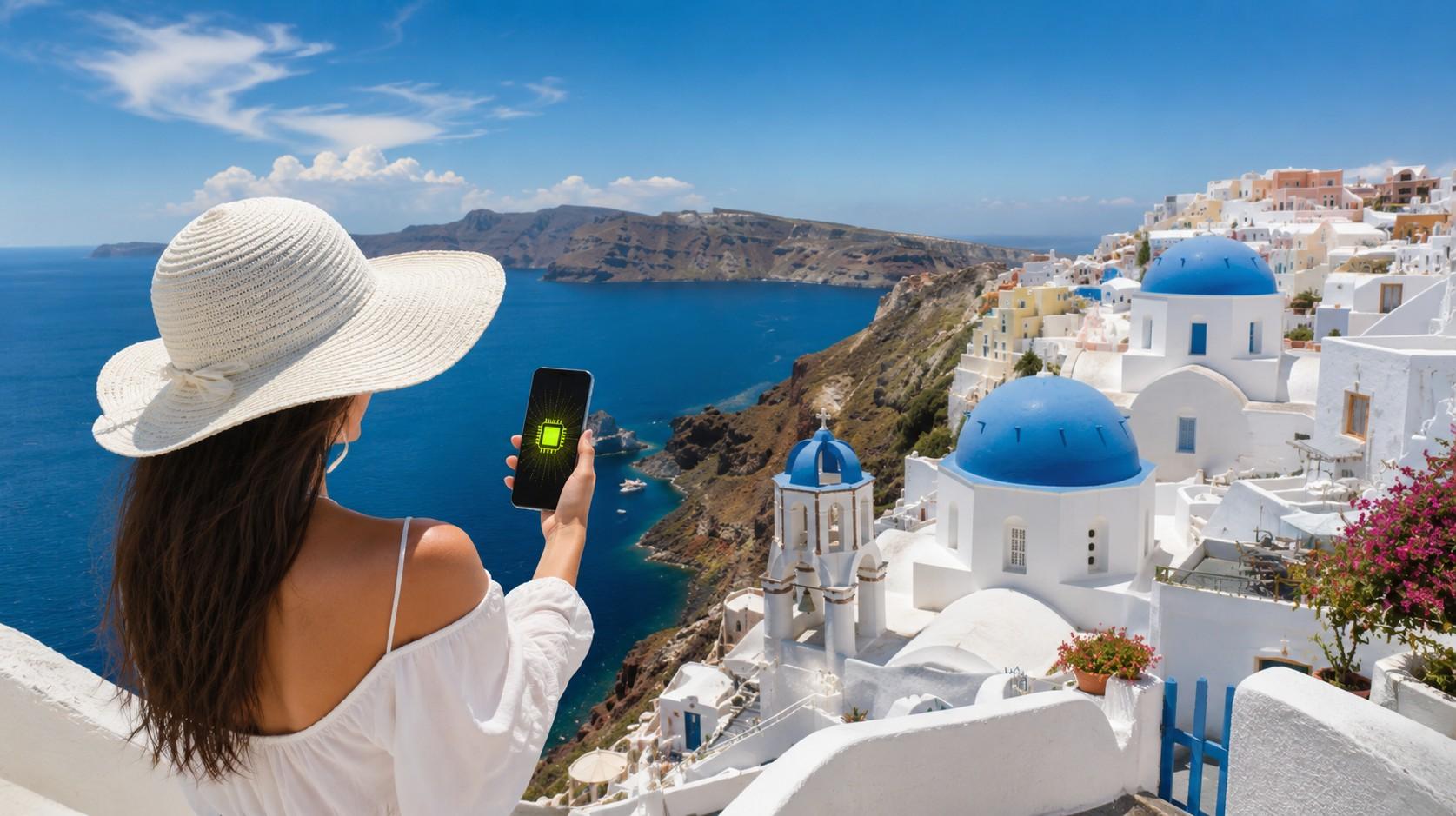
Best eSIM for Greece: Athens, Santorini & Island Data
A Greece eSIM is a prepaid data profile that loads onto your phone before departure and registers on Cosmote, Vodafone Greece, or Nova the moment you land. No plastic card, no kiosk queue at Athens International Airport, no daily roaming fee from your home operator. Vesim plans start at $0.60, cover 220+ countries, and arrive as a QR code by email within minutes of purchase.
Greece draws more than 30 million international visitors a year, and their itineraries rarely sit still. A typical two-week trip touches Athens, a Cyclades island or two, and a ferry crossing in between. Each leg puts a different demand on your connection.
Coverage reflects that geography. 4G reaches above 95 percent of populated territory, and speeds in Athens and Thessaloniki commonly run 25 to 55 Mbps. Smaller Aegean islands and mountain roads behave differently, and the carrier behind your plan decides how much that difference costs you.
Cosmote, part of OTE Group and majority-owned by Deutsche Telekom, holds the widest island footprint. Vodafone Greece and Nova (the operator formerly trading as Wind Hellas) perform strongly in cities and major tourist zones. Knowing which one your profile rides on is more useful than comparing headline prices.
This guide walks through network choice, coverage across Athens, Santorini, Mykonos, Crete, and the smaller islands, what happens to your signal on the ferry, realistic data allowances by trip type, and the installation sequence on iPhone and Android. Twelve questions at the end cover ferry dead zones, tethering, hotspot rules, and what to do when a plan expires mid-trip.
Why travelers skip roaming and airport SIM counters
Roaming from a US or UK carrier bills by the day, and a fourteen-day Greek itinerary turns that into a number worth avoiding. The alternative at the airport is a physical card, sold at counters inside the Athens (ATH) arrivals hall, and those counters run their own hours and their own lines. Peak-season queues at Vodafone and Cosmote desks have been known to run half an hour or longer.
Buying online removes both. Purchase happens before departure, the profile installs over home Wi-Fi, and the line connects on arrival while everyone else is still queuing. Your original number stays live on the first line, so calls and verification codes keep working.
One more advantage matters for island trips: you never need to find an open shop on a Saturday afternoon in Naxos. The plan you bought at home follows the ferry. Which network it connects to is the next question.
Greek mobile networks: Cosmote, Vodafone, and Nova
Cosmote leads on subscriber numbers and, more importantly for travelers, on reach. It is the only operator with dependable service on the smaller Aegean destinations, including Milos, Naxos, and Folegandros, plus inland Crete. Providers routing through Cosmote give island-hoppers the fewest dead spots.
Vodafone Greece delivers excellent performance in Athens, Thessaloniki, and the headline resorts. Signal can fall back to slower technology in remote villages and mountainous interiors.
Nova covers the same urban strongholds well and is common among unlimited-style products. Its weakness shows on the outer islands rather than in the cities.
All three operate nationwide 4G and are rolling 5G into the larger urban centers. For a trip built around Athens and one or two major islands, any of them works. For a route through the smaller Cyclades, the operator behind your plan becomes the deciding factor. Coverage on the ground shows exactly why.
Coverage across Athens, Santorini, and the islands
Athens performs consistently. Signal holds around the Acropolis, through Plaka and Monastiraki, across Kolonaki, and along the metro line out to Piraeus. Thessaloniki behaves the same way.
Island coverage varies by size and terrain:
Santorini carries LTE across Fira, Oia, and Akrotiri, with the caldera viewpoints well served and the southern hiking trails weaker
Mykonos holds strong signal in Chora, the port, and the southern beach clubs
Crete performs well along the north coast through Heraklion and Chania, and thins toward Matala, Elafonisi, and Balos in the south
Rhodes and Corfu carry reliable service across the resort belts and old towns
Milos, Naxos, Paros, and Folegandros depend heavily on which carrier you are riding
Meteora and the mountain routes of the mainland interior have usable but inconsistent service. The drive north from Athens through Delphi and Kalambaka passes several stretches where the signal drops for a few kilometers at a time, and the same applies to the Pindus passes further west. Download offline maps before driving them, and save your accommodation address as text rather than a live map pin. The bigger gap on most itineraries is not on land at all.
What happens to your signal on the ferry
Ferry routes between Piraeus and the Cyclades cross long stretches of open water with intermittent service or none. A Blue Star crossing to Santorini runs five to eight hours, and the middle portion of that journey is effectively offline on every Greek network.
Prepare for it rather than troubleshoot it:
Download boarding passes, hotel confirmations, and offline maps before you board
Save your ferry ticket as a screenshot rather than relying on the app to load
Cache playlists, podcasts, and episodes over the port Wi-Fi
Send anyone waiting at the other end your arrival time before departure
Signal returns as the vessel approaches the next island. Nothing is broken, and the profile reconnects on its own. Knowing this in advance also stops you from buying more data than the trip needs.
Greece eSIM pricing and choosing a plan size
Pricing across the travel data market for Greece starts near $3 for 1 GB over a week and reaches roughly $50 for high-allowance monthly packages. Unlimited-style products generally begin around $10 for a short weekend and $20 upward for longer windows. Vesim entry pricing across the catalog starts at $0.60.
Match the allowance to how you travel:
1 GB works for a three-day Athens city break using maps, messaging, and a few uploads
5 GB suits a week across Athens and one island with regular photo posting
10 GB fits a two-week multi-island route with navigation, ferry apps, and social video
20 GB or unlimited makes sense for remote work, evening streaming, or tethering a laptop from a Santorini terrace
Buying slightly above your estimate costs less than buying twice. Cost per gigabyte falls as allowances rise, and a mid-trip top-up on a slow ferry connection is exactly the situation worth avoiding. Once you have picked the plan, setup takes five minutes.
Installing your Greece profile before departure
Check compatibility first. Dial *#06# and look for an EID number on screen. If one appears, your handset accepts digital profiles. iPhone XS and newer, Samsung Galaxy S20 and up plus the Z series, and Pixel 3 and later all qualify.
Then work through the sequence at home:
Order the plan at vesim.global and open the confirmation email
Scan the QR code from a second screen, or enter the SM-DP+ address manually
Name the new line something obvious so you can tell it apart in settings
Land in Greece, set the travel line as your data line
Turn Data Roaming on for the travel line only and keep your home line’s roaming switched off
That final setting is the single most common reason a correctly installed profile shows bars but refuses to load anything. A visiting profile is a roaming guest on Cosmote or Vodafone by design, so the permission has to be granted on the device. Everything above covers the practical setup, and the questions below cover the rest.
Does an eSIM work on the Greek islands?
Yes. Santorini, Mykonos, Crete, Rhodes, Corfu, Paros, and Naxos all carry 4G, and travel profiles connect through the same towers local customers use. Coverage on the smallest islands depends on which operator your plan routes through, with Cosmote reaching furthest.
Which Greek network has the best island coverage?
Cosmote. It runs the widest footprint across the Aegean and Ionian groups, including Milos, Naxos, and Folegandros, and holds up in inland Crete where the other two weaken.
How much data do I need for a week in Greece?
Around 5 GB for a week combining Athens with one island, assuming maps, messaging, ferry apps, and daily photo uploads. Two weeks across several islands is closer to 10 GB, and streaming or tethering pushes it higher.
Will I have signal on the ferry between islands?
Not for most of the crossing. Routes from Piraeus into the Cyclades pass through open water with little or no service. Download tickets, maps, and entertainment before boarding, and expect the connection to return near the destination port.
Can I keep my regular number active?
Yes. The travel line handles data only while your primary SIM stays switched on for calls and texts. Banking codes and two-factor messages arrive normally, which is why keeping both lines enabled is worth the extra battery.
What is the difference between a travel profile and a Greek SIM card?
A travel profile installs over the internet, needs no counter visit, and can be bought weeks in advance from another country. A local card is issued in person at an airport or high-street shop and locks you to a single operator. Both reach the same networks.
Is 5G available in Greece?
In the cities. Athens and Thessaloniki have growing 5G, and it appears in parts of the larger tourist centers. 4G is the realistic nationwide expectation and averages 25 to 55 Mbps, which is more than enough for video calls and navigation.
Do I need a passport to buy a Greece data plan?
No. Online purchase requires no identification and no registration, unlike a physical card bought at a counter in Greece where ID is requested at the point of sale.
Can I use one plan across Greece and other European countries?
Country plans cover Greece only. If your route continues into Italy, Turkey, or the Balkans, a regional or multi-country package usually costs less than buying each destination separately. Vesim lists both types across its 220 destinations.
Can I share the connection with a laptop or a friend?
Usually yes. Tethering draws from the same allowance rather than a separate pool, so a work session or a shared connection burns through gigabytes quickly. Check the hotspot rule on the plan page, since some unlimited-style products restrict sharing.
What happens when my plan expires mid-trip?
Data stops and the line goes quiet with no overage charge, because prepaid caps your spend at what you already paid. Buy a fresh plan from your account and the line resumes. Unused gigabytes do not roll past the expiry date.
When should I install it?
Install at home on Wi-Fi one or two days before you fly, then leave the line switched off until you arrive. On most travel packages the validity clock starts when the profile first registers on a network at the destination, not when you buy it.
Summary
A Greece eSIM puts a prepaid data profile on your phone before departure and registers it on Cosmote, Vodafone Greece, or Nova the moment you land, with no kiosk queue and no daily roaming fee. Cosmote reaches furthest across the Aegean, Athens and Thessaloniki hold steady 4G at 25 to 55 Mbps, the islands vary by size and carrier, and the ferry crossings between Piraeus and the Cyclades go quiet in the middle. A week across Athens and one island runs on roughly 5 GB, a multi-island fortnight on 10 GB, and installation over home Wi-Fi takes five minutes from the QR code in your inbox.
Buy your plan at vesim.global before you fly, scan the code at home, then switch on data roaming for the travel line after landing at Athens International Airport. Plans start at $0.60 across 220+ countries.