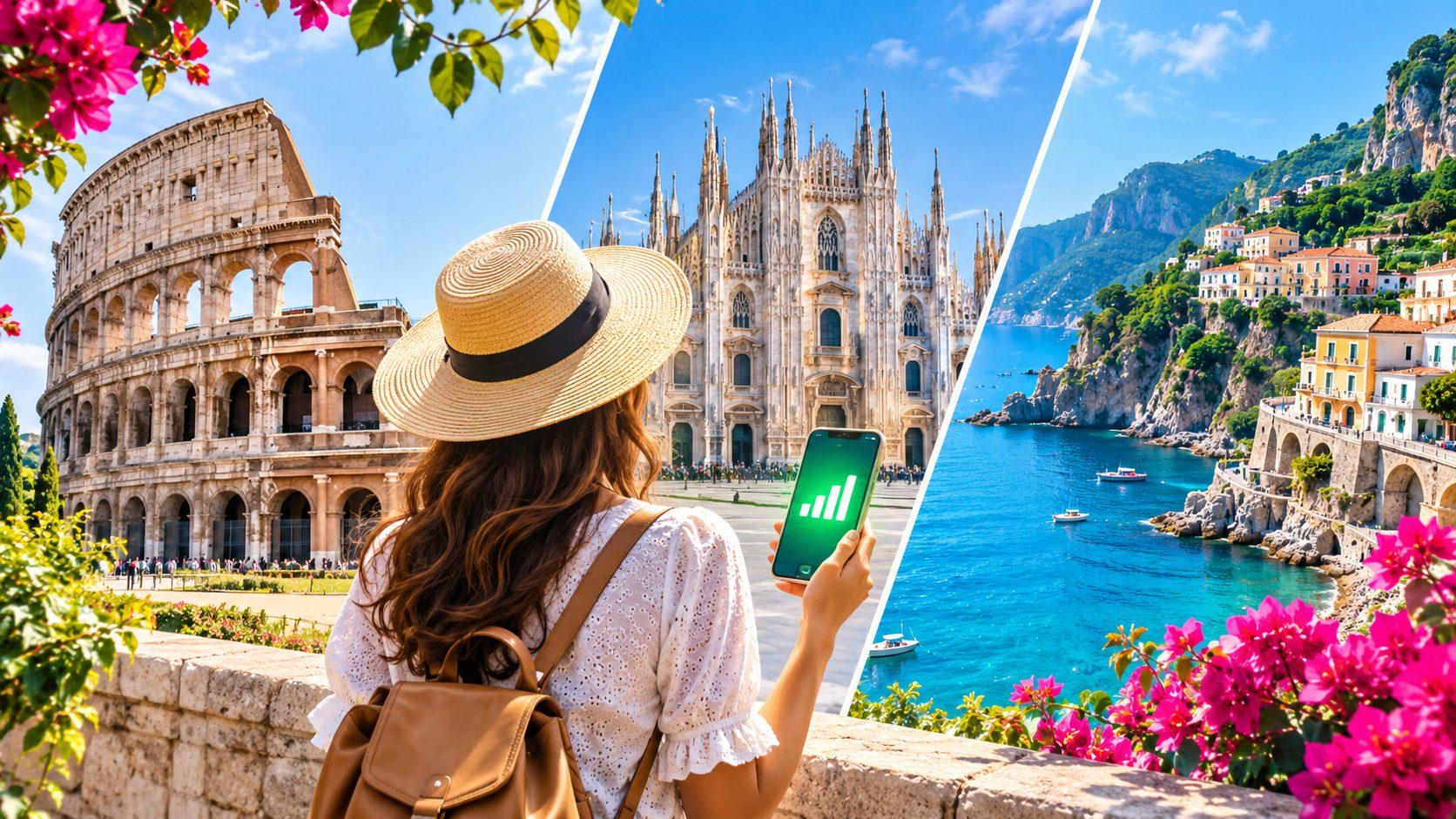
Best eSIM for Italy: Rome, Milan & Amalfi Coast Coverage
An eSIM for Italy is a digital SIM that gives your phone Italian mobile data the moment you land. You scan a QR code at home, and the line connects at Rome Fiumicino or Milan Malpensa. Vesim sells Italy plans from $0.68, with no shop queue and no plastic card to swap.
Italy runs on four mobile networks: TIM, Vodafone, WindTre and Iliad. All four offer 4G across cities, towns and main highways. 5G covers central Rome, Milan, Florence, Naples and most large towns. Visitors from the US, UK and Canada face roaming fees at home. A travel eSIM saves money from day one.
Coverage changes with the ground. Rome's center and the Vatican get fast speeds, and Italy's networks cover Vatican City too. Milan's Metro and airports hold a solid signal. Lake Como sits on the Swiss border, where your phone can drift onto a non EU network.
The Amalfi Coast is the tricky part. Cliffs, tunnels and hairpin bends on the coastal road between Positano and Amalfi cause short dips. Ravello and the Path of the Gods hiking trail have patchy stretches. High speed trains keep a good signal on most routes, but the Florence to Bologna line runs mostly through tunnels.
Data needs stay simple. Museum tickets, train apps, maps and messaging use about 1 to 2 GB a day. Setup takes five minutes before you fly.
Why an eSIM for Italy beats roaming and airport SIMs
An eSIM for Italy costs less than home roaming and skips the airport SIM counter. Many US carriers charge a daily fee for international use, which adds up over a week. Airport kiosks charge tourist prices and need your passport. An eSIM installs at home and works as soon as you land.
Each option has a catch worth knowing:
Home roaming: simple, but daily passes add up fast on a 10 day trip.
Airport SIM: local rates, but you queue, show a passport and swap cards.
Pocket Wi-Fi: shares data, but adds a device to carry and charge.
Travel eSIM: local data on arrival, with your home SIM kept in place.
Keeping your home SIM matters more than it seems. Banks send login codes by text, and those codes still reach your home line while the eSIM handles data. Turn off data roaming on the home line to avoid charges. Then all browsing, maps and WhatsApp traffic runs through the travel line.
EU residents get a different deal. EU roaming rules let them use home data in Italy at no extra cost, within fair use limits. For everyone else, a travel plan is usually the cheapest route.
Your plan then rides on one of Italy's four networks.
Italian mobile networks: TIM, Vodafone, WindTre and Iliad
Italy has four main mobile networks: TIM, Vodafone, WindTre and Iliad. TIM and Vodafone have the widest rural reach. WindTre covers cities and highways well. Iliad, the newest, has grown fast in urban areas. A travel eSIM connects through partner networks, and your phone picks the strongest signal it can join.
Each network has a slightly different footprint:
TIM: the former state carrier, with deep coverage in small towns and the south.
Vodafone: strong in cities and along the main motorways.
WindTre: formed from the Wind and Tre merger, with broad 4G across the country.
Iliad: the youngest network, strongest in large cities.
You don't pick the network when you buy. The provider sets up the partner deals. Your status bar then shows the network name, such as "TIM" or "vodafone IT", once you connect.
If a plan supports more than one Italian partner, your phone can switch when one fades. That helps most on the Amalfi Coast and in mountain areas. Local prepaid SIMs from these networks also exist, but shops ask for your passport and register you on the spot.
Rome is where most trips start, so its coverage comes first.
Rome coverage: Metro, Vatican and day trips
Rome has fast 4G and 5G across the historic center, Trastevere and the Vatican. Italian networks also serve Vatican City, so your Italy plan works there. Most Metro stations on lines A, B and C have signal. Day trips to Tivoli, Ostia Antica and Orvieto stay well covered too.
Rome trips lean on data at a few key moments. Most involve a QR code at a gate:
Colosseum and Forum tickets: timed entry tickets often live in an app or email QR code.
Vatican Museums: online tickets skip a long line, and staff scan them at the door.
Transport: the ATAC network and the Leonardo Express from Fiumicino use digital tickets.
Taxis: Uber in Rome offers mostly premium cars, so many visitors use FreeNow or itTaxi.
Streets near the Pantheon and Piazza Navona get crowded, and busy cells can slow down at peak hours. Speeds usually recover a block away. Inside the basilica and deep in the Vatican Museums, thick walls weaken the signal. Download your ticket to your phone before you enter.
The Leonardo Express runs from Fiumicino to Roma Termini in about 32 minutes. Signal holds for most of the ride. That gives you time to check your hotel route on arrival.
From Rome, many visitors head north to Milan.
Milan coverage: airports, Metro and Lake Como
Milan has strong 4G and 5G across the center, the Duomo area and Navigli. Malpensa and Linate airports both get solid coverage on arrival. The Metro network carries signal in stations. Lake Como needs care, because it sits near Switzerland and your phone may join a Swiss network.
Milan's main data points look like this:
Malpensa: the Malpensa Express reaches the city in about 50 minutes, with signal for most of the ride.
Linate: the M4 Metro line links the airport to the center.
Duomo and Galleria: crowds are heavy, but 5G handles the load well.
Navigli: the canal district has good coverage for evening maps and bookings.
Lake Como is the big trap. Como town sits a few minutes from the Swiss town of Chiasso. Switzerland isn't in the EU, and many Italy plans don't cover it. If your phone grabs a Swiss network, data can stop.
To stay on an Italian network near the border, open your network settings. On iPhone, go to Settings, Cellular, your travel line, then Network Selection. On Android, go to Mobile networks, then Network operators. Turn off automatic mode and pick TIM, Vodafone, WindTre or Iliad. The guide to one Europe plan for 30+ countries helps if you plan to cross into Switzerland.
The south brings a different challenge on the Amalfi Coast.
Amalfi Coast coverage: Positano, Amalfi and Ravello
The Amalfi Coast has good 4G in Positano, Amalfi and Ravello town centers. Signal dips on the coastal road between them, where cliffs and tunnels block towers. The Path of the Gods trail has patchy stretches. Ferries keep a signal near ports but can lose it offshore. Offline maps help here.
Most coverage gaps on the coast are short and predictable:
Coastal road: bends and tunnels on the SS163 cause drops of a minute or two.
Positano: steps and narrow lanes sit below the main towers, so indoor signal can be weak.
Ravello: the hilltop town has good signal in the main square and gardens.
Path of the Gods: the trail from Bomerano to Nocelle loses signal in spots.
Ferries: boats from Positano and Amalfi to Capri hold signal near the shore.
Bus and ferry tickets often sell through apps or QR codes. Buy them while you have signal in town, not at a stop on a cliff. Hotel Wi-Fi in older buildings can be slow, so your eSIM often becomes the main connection.
Sorrento and Naples act as gateways. Both have strong coverage, and the train from Naples to Sorrento holds a signal for most of the ride. Capri itself has good coverage in town and around the Piazzetta.
Driving the coast brings its own data needs. Many Italian towns use ZTL zones, where cameras fine cars that enter without a permit. Live maps warn you before you enter one. Parking apps and toll payments also run on data, so keep your line active while you drive.
The next section sums up coverage at each stop.
Italy coverage at a glance
Italy's coverage is strongest in cities and weakest on cliffs, trails and long tunnels. Rome, Milan, Florence and Naples get fast speeds. The Amalfi Coast and high speed rail tunnels cause short drops. The table shows each area and one practical tip for keeping your data working.
High speed trains: Rome, Florence, Milan and Naples
High speed trains in Italy keep a usable signal on most of the route. Frecciarossa and Italo trains link Rome and Milan in about three hours. The Florence to Bologna stretch runs mostly through tunnels, so expect a long gap there. Both operators offer onboard Wi-Fi, but it slows when trains are full.
Plan your rail data around a few facts:
Buy tickets in the Trenitalia or Italo app, then save the QR code to your wallet.
Download playlists, shows and maps before you board in Rome or Milan.
Send work files before the Florence to Bologna section.
Use your eSIM as a backup when onboard Wi-Fi slows down.
Regional trains run slower and stay above ground more often. They also cost less and need no seat booking, so many visitors use them for short hops. Routes such as Florence to Pisa or Naples to Salerno hold a steadier signal. Station Wi-Fi exists in big hubs like Roma Termini and Milano Centrale.
Knowing where signal drops helps you size your data plan.
How much data an Italy trip uses
A typical Italy trip uses about 1 to 2 GB per day. Maps, ticket apps, messaging and social posts keep you near 1 GB. Video calls, streaming and photo backups push you to 2 GB or more. A 10 day trip with normal use fits in about 15 GB.
Different habits change the total:
Light use: maps, WhatsApp and email, about 500 MB a day.
Normal use: plus social posts and a few video calls, about 1 to 2 GB a day.
Heavy use: plus streaming and cloud photo backups, 3 GB a day or more.
Shared trips change the math. A couple can buy one plan each, or one person can share data by hotspot if the plan allows it. Families with teens often find separate plans easier, since each phone tracks its own use.
Photo backups are the hidden drain. Italy invites a lot of photos, and iCloud or Google Photos can upload gigabytes over cellular in one evening. Set backups to Wi-Fi only. The travel data calculator guide shows how each app adds up.
Once you know your size, setup is quick.
How to set up your Italy eSIM before you fly
Set up your Italy eSIM at home on Wi-Fi, a day or two before you leave. Buy the plan, scan the QR code and name the line. Turn it on when you land. Then set it as your data line and switch on data roaming for it.
Check that your phone supports eSIM and isn't carrier locked.
Buy a plan on the Vesim Italy eSIM page.
Scan the QR code from a second screen, or enter it by hand.
Label the line "Italy data" so it's easy to find.
Switch the line on and set it for cellular data after landing.
Keep your home line for texts and calls, with its data roaming off.
After landing, check that the status bar shows an Italian network. Open a map to confirm data loads. If nothing loads, restart the phone and check data roaming on the travel line.
Does my Italy eSIM work in Vatican City?
Yes, an Italy eSIM works in Vatican City. The Vatican uses Italian mobile networks, so your phone stays on the same partner. Signal can weaken inside the basilica and the museums.
Which network is best in Italy?
TIM and Vodafone have the widest coverage, especially in rural areas and the south. WindTre and Iliad work well in cities. For a city and coast trip, any of them serves visitors well.
Do I need a passport for an Italian eSIM?
No, a travel eSIM doesn't need a passport check. Local Italian SIMs do, because shops must register each buyer. That's one reason many visitors skip the airport counter.
Will my eSIM work on the Amalfi Coast?
Yes, it works in Positano, Amalfi and Ravello. Expect short drops on the coastal road and some trails. Save tickets and maps while you have signal in town.
What is the Path of the Gods signal like?
The Path of the Gods has patchy signal along parts of the trail. Bomerano and Nocelle have coverage, but some middle sections go quiet. Download an offline map before you start.
Which Italian cities have 5G?
Rome, Milan, Florence, Naples, Turin and Bologna all have wide 5G coverage. Many smaller towns have it too. Your plan and phone both need 5G support.
Is an Italy eSIM cheaper than a Europe plan?
An Italy plan is usually cheaper for a trip that stays in Italy. A Europe plan costs more but covers border trips to Switzerland or France on one line. Pick based on your full route.
How much does an eSIM for Italy cost?
Vesim lists Italy plans from $0.68. Larger data sizes and longer validity cost more. Check the country page for current options.
Your Italy data plan in short
Italy's four networks, TIM, Vodafone, WindTre and Iliad, give visitors fast data in Rome, Milan and most towns. The Vatican sits on Italian networks, so one plan covers it. Lake Como needs a manual network choice near Switzerland. The Amalfi Coast and rail tunnels cause short drops, not long outages.
Plan on 1 to 2 GB a day and keep photo backups on Wi-Fi. Save tickets while you have signal, and set up the line at home. Then your eSIM for Italy is ready when you land at Fiumicino or Malpensa.