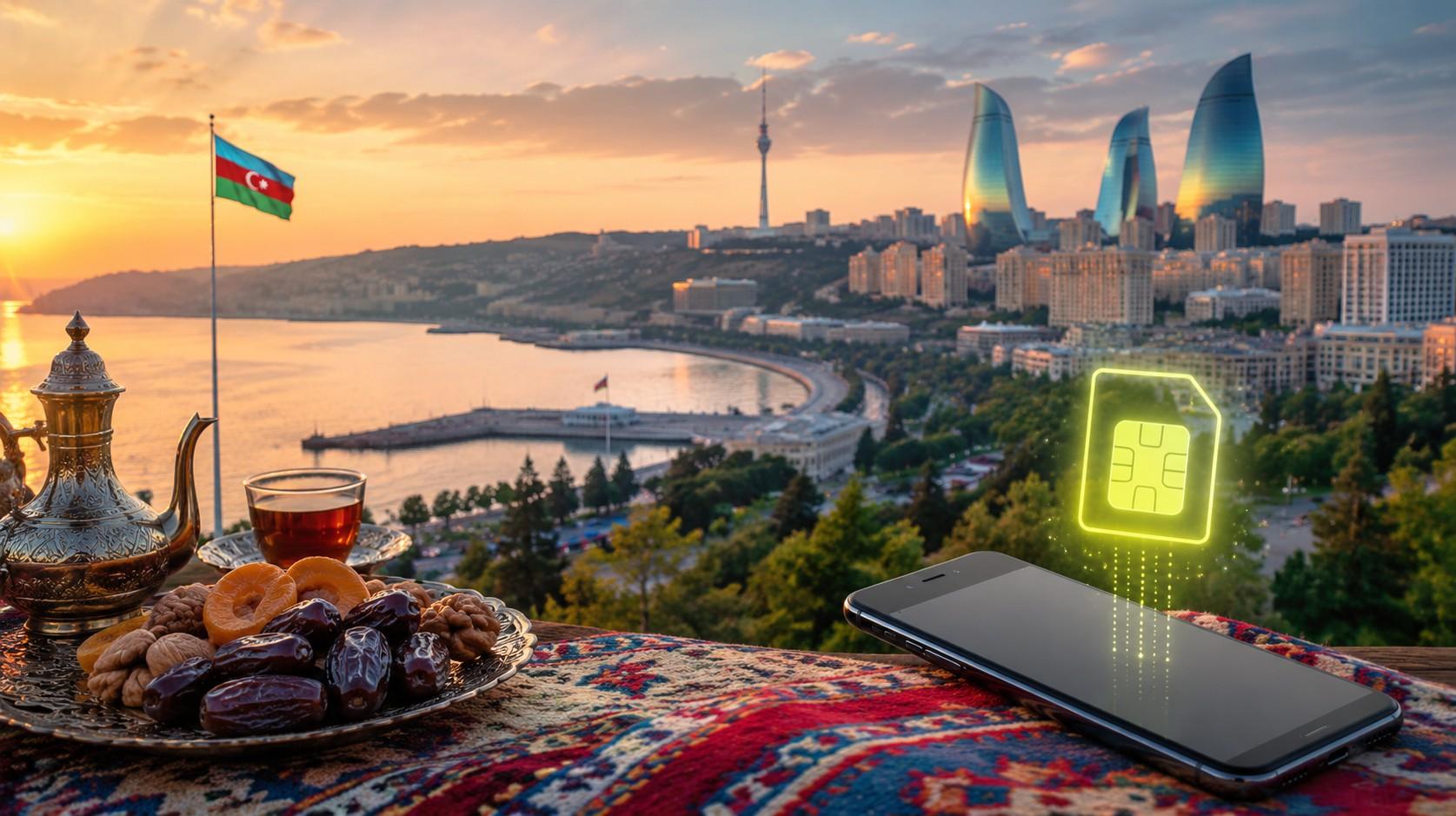
Best eSIM for Azerbaijan: Baku Travel Connectivity
An Azerbaijan eSIM is a digital data profile you install before your flight and switch on after landing. It connects your handset to one of the three local mobile operators without a plastic card, a passport registration desk, or a roaming invoice from your home carrier. Vesim sells prepaid travel data across 220+ countries with plans from $0.60, delivered as a QR code by email and installed in under five minutes.
Azerbaijan runs on three networks: Azercell, Bakcell, and Nar Mobile. All three carry 4G LTE across the populated parts of the country. 5G exists, but it sits mostly in commercial zones inside the capital rather than spread nationwide. That matters when your itinerary stretches past Baku into Ganja, Sheki, Gobustan, or the mountain roads toward Quba.
The State Statistical Committee of the Republic of Azerbaijan reports mobile subscriptions running above the total population, which is what you would expect in a market where dual-SIM phones are normal. Tourists inherit that infrastructure the moment their profile registers.
Most travelers land at Heydar Aliyev International Airport (GYD) around 3:00 AM, because that is when the Gulf and European connections arrive. Kiosks are shut. Taxi drivers want a destination. A profile that activated on your kitchen Wi-Fi two days earlier solves that problem before it starts.
This guide covers what a Baku data plan costs, which operator each carrier partner uses, how coverage behaves outside the capital, how much data a typical trip burns, the setup sequence on iPhone and Android, and how digital profiles compare against airport SIM counters and carrier roaming. Ten questions at the end answer the specifics travelers ask before they buy.
Why travelers to Azerbaijan choose a digital profile
Travelers arriving in Azerbaijan face three connectivity options, and two of them cost time you would rather spend elsewhere. Home carrier roaming charges daily fees that stack across a week. Buying a local card at GYD means finding an open counter, presenting your passport for registration, and waiting behind everyone else from your flight.
Vesim removes both steps. You buy online, scan the code at home, and land with data already provisioned. Your regular number stays live on the primary line for calls and SMS, so bank verification codes still arrive while the travel line handles maps, translation, and ride-hailing.
There is no ID requirement and no store visit. Purchase happens on the website, delivery happens by email, and activation happens on your own schedule. The network choice behind that profile is the next thing worth understanding.
Azerbaijan mobile networks: Azercell, Bakcell, and Nar
Azercell holds the largest subscriber base and the widest geographic footprint, which makes it the safer partner for anyone driving to Sheki, Lahij, or the Caucasus foothills. Rural signal holds better on this network than on either competitor.
Bakcell has invested heavily in the capital and performs strongly across central Baku, the business district, and the waterfront. Its packages tend to price aggressively. Coverage thins faster once you leave the larger cities.
Nar Mobile sits third by subscriber count and works well enough in metropolitan areas. Peak-hour congestion shows up more often on this network in dense districts.
Speeds on 4G LTE in Baku commonly land in the 20 to 60 Mbps range, which handles video calls, uploads, and navigation without complaint. 5G appears in limited high-traffic zones of the capital and should be treated as a bonus rather than a plan requirement. Where those networks reach determines how far your data follows you.
Coverage across Baku and the rest of the country
Coverage inside Baku is dense and consistent. Icherisheher (the walled Old City), the Flame Towers, Seaside Boulevard along the Caspian, Nizami Street, and the Heydar Aliyev Center all sit inside strong signal. Underground sections of the Baku Metro can drop briefly between stations.
Outside the capital, signal quality tracks population:
Ganja, the second city, holds solid LTE across the center and main approach roads
Sheki and Lahij carry usable data in town, with dips on the mountain passes between them
Gobustan and the mud volcano field have workable coverage near the museum and access track
Qabala, Quba, and Lankaran perform well in built-up areas and weaken on forest roads
Naxçıvan, the exclave, is served but sparser than the mainland
Download offline maps before any drive into the Greater Caucasus. Signal returns in the valleys and villages, but the passes between them are unreliable on every network. How much data you allocate depends on where those days fall.
How much data a trip to Azerbaijan actually uses
Data consumption in Azerbaijan mirrors any other city break, with one wrinkle: ride-hailing and translation apps run constantly because Azerbaijani and Russian dominate signage outside tourist zones.
Rough planning figures for a solo traveler:
1 GB covers a long weekend of maps, messaging, and light browsing
3 GB suits a week of the same plus photo uploads and occasional video calls
5 GB to 10 GB fits two weeks, social posting, and music streaming
20 GB or more makes sense for remote work, tethering a laptop, or video streaming in the evenings
Market plans for the country generally run from 1 GB up to 20 GB, with validity windows of 7 to 30 days. Entry tiers across the travel data market start near $4 and 30-day high-data packages reach roughly $50. Unlimited options exist, and a seven-day unlimited plan often costs around $40, which stops making sense the moment your trip runs longer than a week. Buying the right size is easier once the profile is installed and tested.
Installing your Azerbaijan eSIM before departure
Installation takes minutes and belongs on your home Wi-Fi, not on airport internet in Baku. Check compatibility first: dial *#06# and look for an EID number. If one appears, your handset supports digital profiles. iPhone XS and newer, Samsung Galaxy S20 and up plus the Z series, and Pixel 3 and later all qualify.
The sequence:
Buy the plan on vesim.global and open the confirmation email
Scan the QR code from a second screen or enter the SM-DP+ address manually
Label the new line clearly so you can tell it apart from your home number
Set the travel line as your data line after you land
Switch Data Roaming on for the Vesim line only, and leave your home line’s roaming off
That last step causes more support tickets than everything else combined. A travel profile is a visitor on the local network by design, so roaming has to be permitted at the device level for data to flow. Getting that right is what separates a smooth arrival from a queue at the airport counter.
Digital profile versus airport SIM card and carrier roaming
The GYD arrivals hall sells local cards, and they work. The cost is process. Registration requires your passport, counters keep their own hours, and a late-night landing can mean no open kiosk at all.
Home carrier roaming skips the queue and charges for the privilege. Daily international rates from US and European operators frequently exceed the total price of a full prepaid travel package for the same trip.
Vesim prices sit at the other end. Plans start at $0.60, the catalog spans 220+ countries, and one account carries across future trips, so a Caucasus loop through Georgia and Armenia does not mean three separate shop visits. Everything above answers the practical questions, and the ones below answer the rest.
Does an eSIM work in Azerbaijan?
Yes. Azercell, Bakcell, and Nar Mobile all support visiting digital profiles, and travel providers connect through those networks. Install before you fly, then enable roaming on the travel line after landing.
Which network gives the best coverage in Azerbaijan?
Azercell carries the widest rural and regional footprint, which matters for trips beyond the capital. Bakcell competes closely inside Baku itself. Nar Mobile covers metropolitan areas adequately and can slow during peak hours.
How much does an Azerbaijan travel data plan cost?
Vesim plans begin at $0.60, and country packages across the market typically run from about $4 for a small allowance up to roughly $50 for 20 GB over 30 days. Cost per gigabyte drops as the allowance rises, so a slightly larger plan usually beats topping up twice.
Can I keep my own phone number while using a travel profile?
Yes. Your primary SIM stays active for calls and SMS while the second line handles data only. Verification codes from your bank arrive as usual, which is the main reason to keep both lines switched on.
Do I need to register my passport to buy one?
No. Purchase happens online with no documentation and no store visit, unlike a physical card bought at Heydar Aliyev International Airport, where registration is required.
What is the difference between an eSIM and a local SIM card in Baku?
A digital profile downloads over the internet and needs no physical slot, no counter, and no ID check. A local card is issued in person, requires registration, and ties you to that single operator for the trip. Both connect to the same towers.
Is 5G available in Azerbaijan?
Limited. Deployment covers selected commercial and high-traffic areas in Baku rather than the whole country. 4G LTE is the realistic expectation nationwide and delivers 20 to 60 Mbps in the capital.
How much data do I need for a week in Baku?
About 3 GB for maps, messaging, ride-hailing, and photo uploads. Push that to 5 GB if you stream music daily or make regular video calls, and to 10 GB or more if you tether a laptop.
Will my data work in Gobustan and Sheki?
Yes, in the towns. Populated areas across Gobustan, Sheki, Qabala, and Quba hold usable LTE. Mountain passes and forest roads between them drop out on every operator, so save offline maps before you set off.
When should I install the profile?
Install it at home on Wi-Fi one or two days before departure, and leave the line switched off until you land. The plan clock on most travel packages begins when the profile first registers on a network at your destination, not at the moment of purchase.
Can I share the connection with a laptop or a travel companion?
Usually yes. Tethering works on most prepaid travel plans, and shared traffic draws from the same allowance rather than a separate pool. A laptop pulls data far faster than a phone does, so size the package upward if a work session or a second device is part of the plan. Check the hotspot rule on the plan page before you rely on it, because a handful of unlimited-style products across the market restrict sharing.
What happens when the plan runs out or expires?
Data stops and the profile goes quiet, but nothing on your handset breaks and no overage charge appears. Prepaid means the price you paid is the price you pay. Buy a fresh plan from your account and the same line picks up again, which is quicker than repeating the whole install. Unused gigabytes do not survive the expiry date, so match the validity window to your itinerary rather than buying the largest package on the list.
Summary
An Azerbaijan eSIM gives you a digital data profile that registers on Azercell, Bakcell, or Nar Mobile as soon as your flight lands, with no plastic card and no passport desk. Coverage is dense across Baku and the second cities, thinner on the Caucasus passes, and built on 4G LTE with 5G confined to parts of the capital. A week in the capital runs comfortably on 3 GB, a longer stretch of remote work needs 10 GB or more, and installation on home Wi-Fi takes five minutes with the QR code from your email.
Buy your plan at vesim.global, scan the code before you fly, and switch on data roaming for the travel line after touchdown at Heydar Aliyev International Airport. Plans start at $0.60 across 220+ countries.